



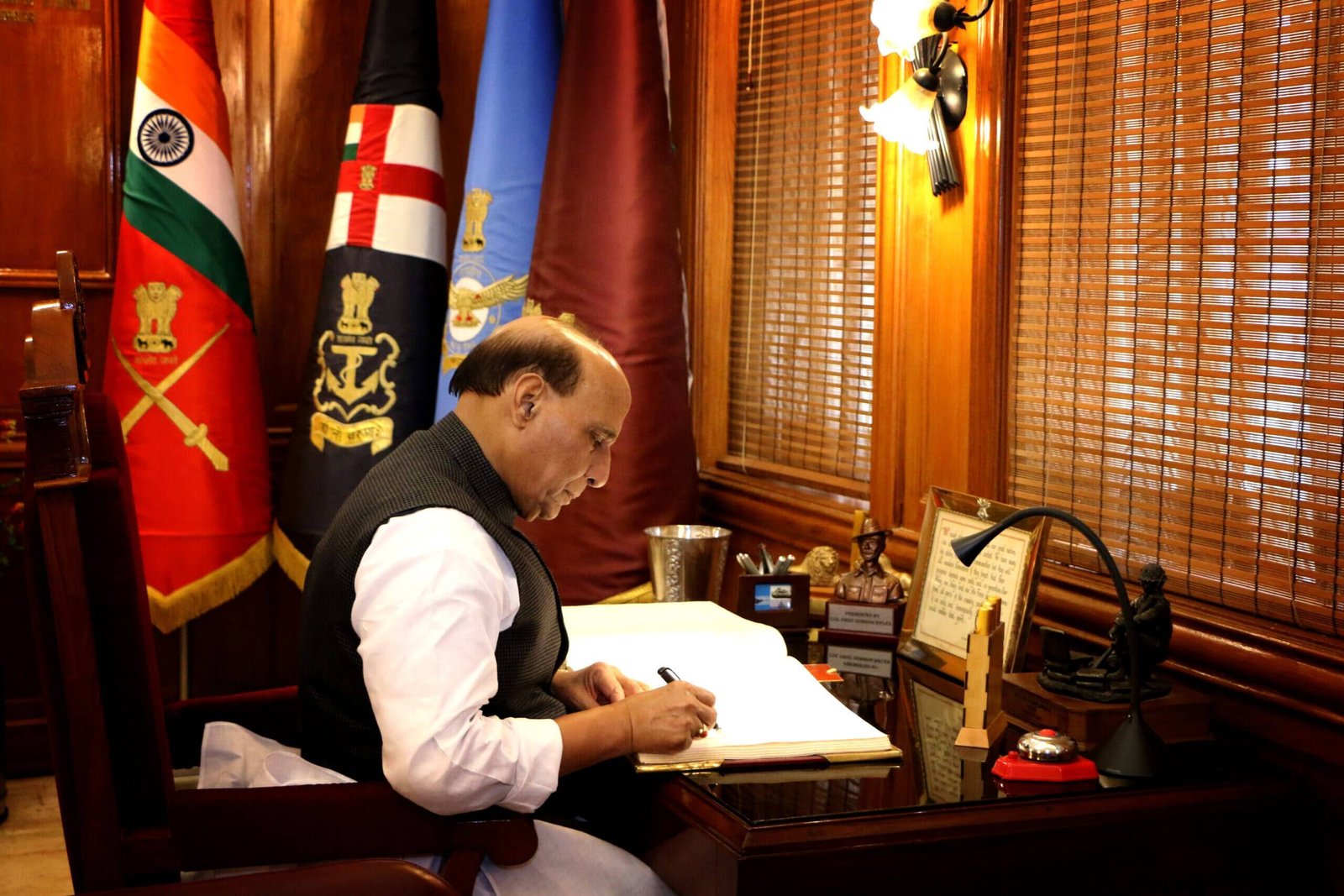
NEW DELHI — In a comprehensive review of India’s economic, technological, and strategic trajectory over the past 12 years, Raksha Mantri Shri Rajnath Singh declared that the nation has successfully transitioned from an era of persistent shortages to one of robust self-reliance and growing global stature. Speaking at a media event in New Delhi on July 4, 2026, the Defence Minister detailed the structural reforms that are laying the foundation for a developed nation, or Viksit Bharat.
A Three-Term Roadmap to Development
Reflecting on the administrative shifts since 2014, Shri Rajnath Singh broke down the government’s progression into distinct phases:
-
First Term: Focused on addressing critical shortages, expanding public opportunities, and transforming administrative work culture.
-
Second Term: Turned national aspirations into tangible achievements, firmly establishing the path of Aatmanirbharta (self-reliance).
-
Third Term: Actively executing the policy of “Reform, Perform, Transform” to build a rock-solid foundation for a developed India, with the ultimate realization projected for the fourth term.
Defense Production and Exports Hit Historic Highs
The defense sector stands as the primary indicator of this transformation, shifting from heavy import dependence to a manufacturing powerhouse under the Make-in-India initiative.
Key Milestone: Annual defense production touched an all-time high of ₹1.78 lakh crore in Financial Year (FY) 2025-26, marking a threefold increase compared to FY 2014-15.
Simultaneously, global confidence in Indian manufacturing platforms has driven a massive surge in trade. Defence exports scaled to an unprecedented ₹38,000 crore, representing an astronomical 57-fold increase from the meager ₹686 crore recorded in FY 2013-14.
Technological Leaps: Semiconductors, 5G, and Digital Scale
Dismissing early skepticism surrounding domestic high-tech manufacturing, the Raksha Mantri highlighted several key breakthroughs:
-
India Semiconductor Mission: Following its 2021 launch, the nation successfully manufactured its indigenous semiconductor chips last year, aided by a “plug-and-play” infrastructure model across newly established semiconductor parks.
-
Telecom Revolution: The country executed a rapid nationwide rollout of indigenously developed 5G technology, with state research institutions now actively steering efforts toward 6G development.
-
Digital Public Infrastructure: India’s financial technology ecosystem achieved massive scale, processing 22.35 billion UPI transactions in April alone, totaling a value of ₹29 lakh crore while expanding its footprint internationally.
Economic Governance and Welfare Delivery
The address brought focus to the systematic eradication of systemic leakages that historically plagued welfare distribution. By deploying the ‘JAM Trinity’ (Jan Dhan, Aadhaar, and Mobile) alongside Direct Benefit Transfer (DBT), the government successfully routed ₹51 lakh crore directly into beneficiaries’ bank accounts. This integration effectively prevented administrative leakages worth ₹4.3 lakh crore.
Furthermore, systemic ease of doing business reforms like the Jan Vishwas initiatives have propelled India to become the world’s third-largest startup ecosystem. Over the last 12 years, the number of active startups has skyrocketed from 500 to over 2 lakh, while corporate unicorns have risen from 4 to 125.
On tax administration, the Goods and Services Tax (GST) was praised for evolving beyond early implementation anxieties into a robust model of cooperative federalism, strengthening fiscal coordination between the Centre, States, and Union Territories.
Security Resolutions and Cultural Revival
Shri Rajnath Singh pointed to the abrogation of Article 370 in Jammu & Kashmir and the sustained, targeted operations to eliminate Naxalism as clear examples of political resolve in settling security issues once deemed impossible to resolve.
This security and economic matrix has been paired with a conscious cultural revival aimed at restoring lost heritage. Key projects highlighted included the Kashi Vishwanath Dham Corridor, Mahakal Lok, the Maa Kamakhya Divya Lok Pariyojana, and the symbolic installation of the ‘Sengol’ in Parliament.
The Media’s Responsibility in the Age of AI
Closing his address, the Raksha Mantri turned his attention to the evolving challenges of modern journalism within an environment of “communicative abundance.” While recognizing that Artificial Intelligence (AI) is fundamentally reshaping journalism by making processing faster and more precise, he asserted that technology cannot replace human intellect.
“The future success of journalism will depend on how well it establishes a balance and synergy between the capabilities of AI and human empathy,” Singh stated, emphasizing that emotional intelligence is what ensures reporting remains humane and credible.
He concluded with a stern reminder regarding national security reporting, warning that misinformation severely degrades public safety and the morale of the armed forces. When handling matters concerning defense or the sacrifices of military personnel, Singh emphasized that speed must never supersede accuracy, calling on the media to fiercely protect the core tenets of accuracy, objectivity, and impartiality.
