



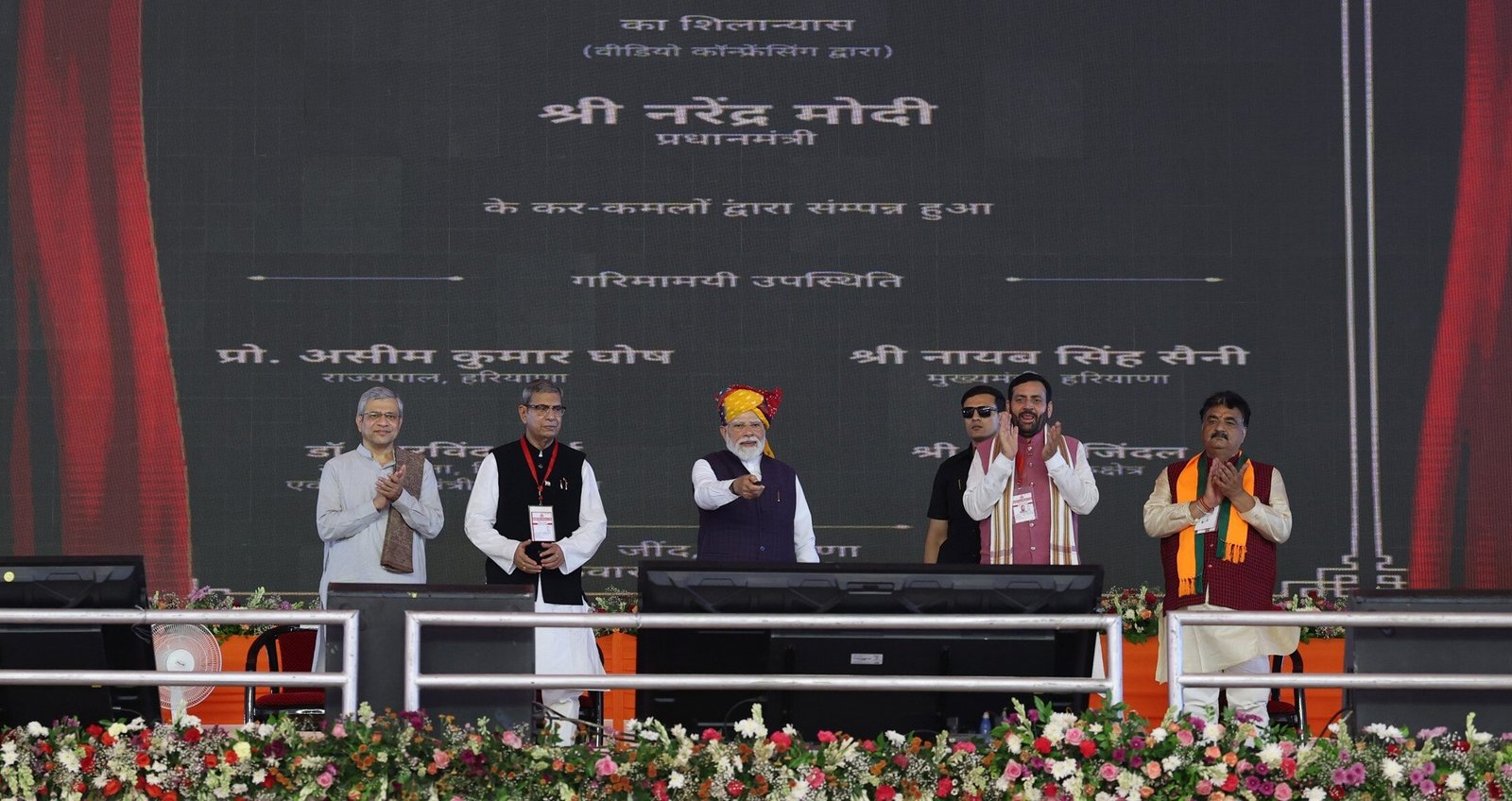
JIND — In a major infrastructure push ahead of the state’s upcoming developmental phase, Prime Minister Narendra Modi visited Jind, Haryana, to dedicate and lay the foundation stones for a massive basket of projects valued at approximately ₹14,700 crore.
Spanning clean mobility, highway logistics, ultra-modern healthcare facilities, and cultural preservation, the comprehensive development package is engineered to heavily accelerate Haryana’s economic output and elevate the regional ‘Ease of Living’.
Technology Leap: The World’s Most Powerful Hydrogen Train
Marking a paradigm shift in Indian transport history, the Prime Minister officially flagged off the country’s first-ever hydrogen fuel cell passenger train on the newly operating 90-kilometer Jind-Sonipat route.
-
Global Prowess: While international hydrogen rail models typically operate with only 3 to 4 coaches in preliminary phases, India has launched a massive 10-coach train straightaway.
-
Formidable Specifications: The state-of-the-art rolling stock is powered by a 3,200-horsepower system, making it the most powerful hydrogen-propelled passenger train globally.
-
“Make in India” Milestone: The entirely zero-emission, smoke-free train was completely designed by domestic engineers and constructed by local manufacturing units, serving as a flagship triumph for indigenous heavy engineering.
-
Electrification Insulation: Highlighting the volatile conflict in West Asia and maritime shipping blockades that disrupt petroleum imports, the PM noted that India’s aggressive electrification push (achieving 100% network electrification in Haryana) successfully insulated the national rail grid from a global fuel crisis.
Industrial Connectivity & Agrarian Logistics
The Prime Minister inaugurated a network of key highway alignments to turn Jind into an advanced logistics hub connected by five distinct national highways:
-
Expressway Infrastructure: The Prime Minister officially launched the local section of the high-speed Delhi-Amritsar-Katra Expressway, the Jind-Gohana National Highway, and the Ambala-Kala Amb four-lane highway project.
-
Economic Ripple Effect: This robust multi-state network will dramatically lower transit costs, giving local farmers, livestock breeders, and dairy micro-enterprises immediate, cheaper access to major domestic commercial markets.
Healthcare, Agriculture, and Cultural Heritage Assets
Beyond transport, the multi-sectoral allocation infuses fresh capital into public welfare systems:
-
Medical Infrastructure: To expand institutional health access, the PM dedicated Pandit Neki Ram Sharma Medical College (Bhiwani) and Maharishi Chyavan Medical College, alongside the Rao Tularam Hospital (Narnaul).
-
Direct Agrarian Subsidies: Reinforcing state welfare, the PM stated that Haryana’s farmers have received close to ₹8,000 crore via the PM Kisan Samman Nidhi, with more than ₹600 crore directly wired into the bank accounts of farmers in Jind alone.
-
Preserving the Guru Tradition: Celebrating the spiritual history of the land, the foundation stone was laid for a brand-new, modern Sikh Museum in Kurukshetra to formally archive and transmit India’s spiritual legacy to future generations.
Global Sports Strategy: The Path to the 2036 Olympics
Reflecting on recent bilateral diplomatic missions to Indonesia, Australia, and New Zealand, the Prime Minister revealed that India is aggressively structuring international partnerships to build a global-standard sports industry.
The Athletic Roadmap: Bolstered by the National Sports Policy and the TOPS Scheme, the Prime Minister announced that the government is actively preparing infrastructure to host the 2030 Commonwealth Games, ahead of launching India’s ambitious national bid to host the 2036 Olympic Games. He assured young athletes that the state will provide unparalleled, elite training resources to prepare them for the global stage.
