



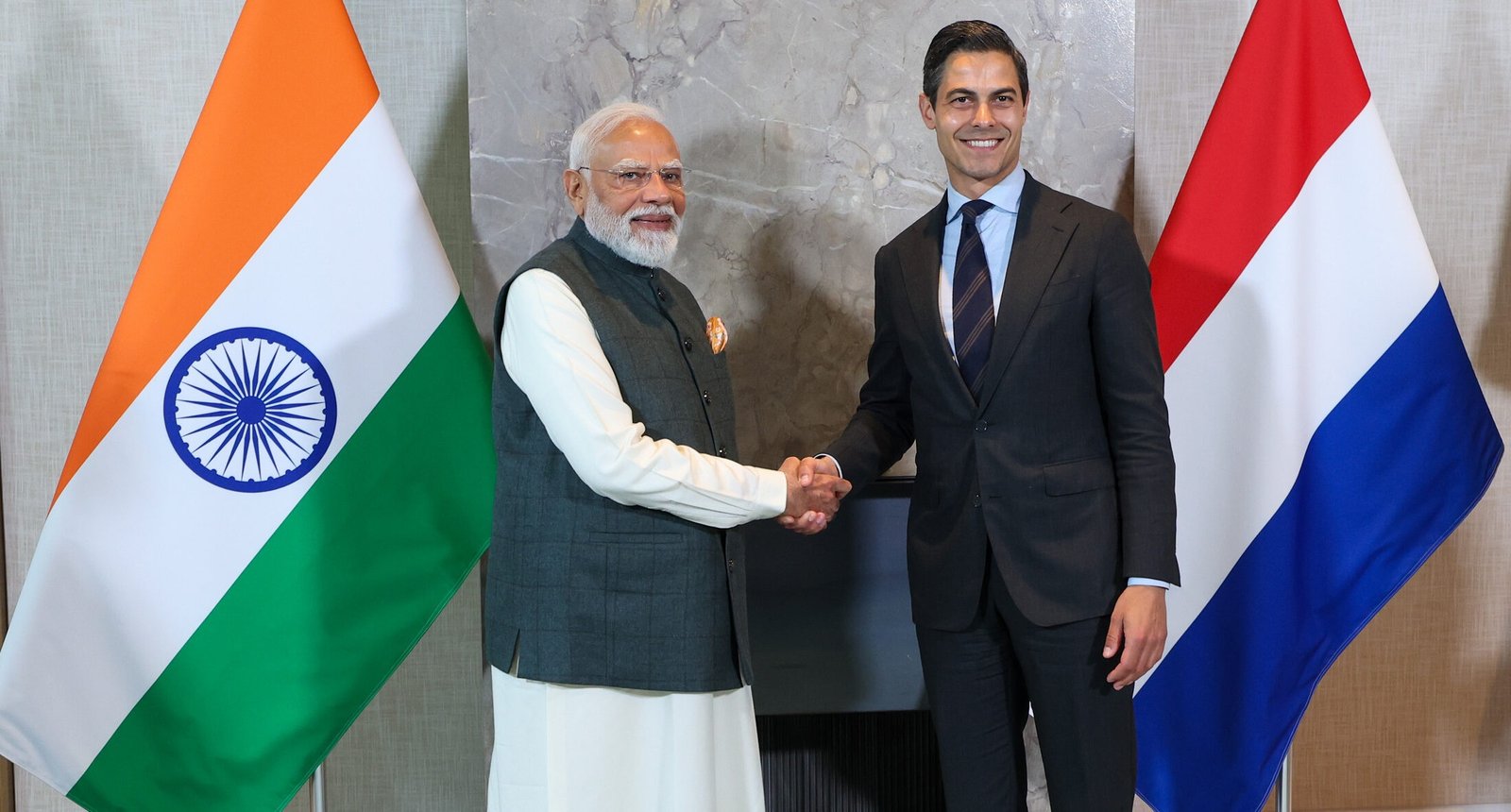
THE HAGUE: Marking a historic milestone in bilateral relations, India and the Netherlands have officially elevated their ties to a ‘Strategic Partnership’. The announcement came during Prime Minister Narendra Modi’s official visit to the Netherlands from May 16–17, 2026, at the invitation of the Dutch Prime Minister, Rob Jetten.
During the high-profile tour, PM Modi was hosted by Their Majesties King Willem-Alexander and Queen Maxima at the Royal Palace Huis ten Bosch, followed by extensive delegation-level talks with PM Jetten to map out a comprehensive Strategic Partnership Roadmap.
Strategic & Geopolitical Alignments
The two leaders signed several landmark pacts to strengthen defense, cyber infrastructure, and international law:
-
Indo-Pacific Alliance: Highlighting the commitment to a free, open, and rules-based Indo-Pacific, the Netherlands announced its decision to join the Indo-Pacific Oceans Initiative (IPOI), co-leading the Capacity Building & Resource Sharing pillar alongside Germany and the EU.
-
UNSC Reforms: The Netherlands reaffirmed its unwavering support for India’s permanent membership in a reformed and expanded UN Security Council.
-
Counter-Terrorism: PM Jetten strongly condemned the April 2025 terrorist attack in Pahalgam (Jammu & Kashmir), with both nations calling for a zero-tolerance approach and support for India’s proposed Comprehensive Convention on International Terrorism (CCIT).
-
Global Conflicts: The leaders expressed deep concern over the ongoing wars in Ukraine and West Asia, welcoming the April 8, 2026 ceasefire in the Middle East and calling for unimpeded commerce through the Strait of Hormuz.
Economic, Tech, and Semiconductor Deep-Dive
With the bilateral ecosystem heavily backed by the newly concluded India-EU Free Trade Agreement (signed January 2026), the economic talks focused on deep technological integration:
-
Semiconductor Brain Bridge: A major Memorandum of Cooperation was adopted between the Eindhoven University of Technology, University of Twente, and six premier Indian institutes (IISc Bangalore, IIT Bombay, IIT Delhi, IIT Gandhinagar, IIT Guwahati, and IIT Madras). Backed by tech giants ASML, NXP, TATA, and CG Semi, this initiative creates an R&D pipeline for hardware engineering.
-
Critical Minerals: To secure high-tech manufacturing supply chains, both nations signed an MoU on Critical Minerals focusing on exploration, circularity, and ESG standards.
-
Customs Enforcement: An Agreement on Mutual Administrative Assistance in Customs Matters was signed to ease trade bottlenecks and secure shipping routes into the Port of Rotterdam.
Energy Transition & Circular Economy
To combat climate change, the two nations aligned their respective environmental policies through cross-border investments:
-
Green Hydrogen Roadmap: Launch of the India-Netherlands Roadmap on the Development of Green Hydrogen to scale up production, export capabilities, and clean fuel adoption.
-
Biofuels & Bio-economy: The Netherlands officially joined the Global Biofuel Alliance, expanding on the success of the joint Mission Innovation Program on Biorefineries.
-
Circular Economy: Capitalizing on India’s presidency of the World Circular Economy Forum (WCEF) 2026, Dutch businesses were invited to invest in urban waste management and interoperable EV-charging infrastructure.
Water Management, Health, and Agriculture
-
Centre of Excellence on Water: Established at IIT Delhi in collaboration with the Dutch Ministry of Infrastructure & Water Management, boosting projects like the Namami Gange Mission and the Kalpasar Project in Gujarat.
-
Healthcare Collaboration: Signed an MoU on Healthcare and Public Health alongside a Letter of Intent between the ICMR and the Dutch RIVM to coordinate on disease surveillance, digital health, and pharmaceutical supply chain security.
-
Dairy & Horticulture: Launch of an Indo-Dutch Center of Excellence on Training in Dairy in Bengaluru, alongside an agreement to build Clean Plant Centres (CPCs) to boost disease-free fruit and crop yields in India.
People-to-People Ties & Cultural Restitution
A defining moment of cultural diplomacy saw the restitution of Chola Era Copper Plates from the University of Leiden back to Indian authorities. Furthermore, a new MoU on Migration and Mobility was signed to ensure legal, streamlined, and fair visa pipelines for highly skilled tech professionals moving between the two economic hubs.
To honor maritime history, Amsterdam’s National Maritime Museum signed an agreement to assist India in developing the National Maritime Heritage Complex (NMHC) at the ancient port city of Lothal, Gujarat.
