



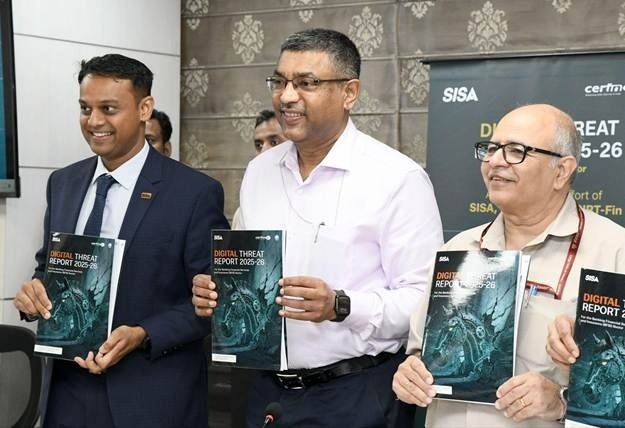
NEW DELHI — Addressing the rapid evolution of sophisticated financial cybercrime, the Ministry of Electronics and Information Technology (MeitY), in tandem with the Indian Computer Emergency Response Team (CERT-In) and the financial sector’s nodal agency CSIRT-Fin, has officially released the second edition of the Digital Threat Report 2025–26 for the Banking, Financial Services, and Insurance (BFSI) sector.
Developed in strategic collaboration with global payment security leader SISA, the comprehensive study maps the critical vulnerabilities reshaping digital banking and payment networks across the country.
Key Insignia: The Shifting Threat Landscape
The central finding of the 2025–26 report highlights a dramatic compression in the weaponization cycle: the time gap between the conceptual discovery of a software vulnerability and its active operational exploitation by criminal syndicates has shrunk from years down to weeks.
-
AI Asymmetry: The report flags the rise of “adversarial AI” as a primary structural threat. Low-resource malicious actors are increasingly deploying machine-speed automated tools to execute highly complex social engineering, credential theft, and supply-chain breaches, outpacing traditional human-led defensive protocols.
-
The Deceptive Threat Vector: Modern cyber intrusions no longer surface as traditional system anomalies. Instead, threat actors exploit compromised clouds and stolen digital IDs to blend seamlessly into legitimate user sessions and ordinary operational workflows, making breaches virtually indistinguishable from genuine transactions until the damage is already done.
The Anatomy of Cyber Failure Framework
To assist Chief Information Security Officers (CISOs) in understanding why robust legacy perimeter defenses are still falling short, the report introduces a diagnostic architecture: The 4-Layer Gap Archetype Framework.
Rather than viewing an intrusion as an isolated system glitch, this framework maps out the sequential compounding weaknesses—ranging from initial access points to deep internal lateral movements—helping institutional boards prioritize cyber risk management as a core corporate governance requirement rather than a mere IT technicality.
Directives from the Leadership
Launching the document in New Delhi, Shri S. Krishnan, Secretary, MeitY, emphasized the collective responsibility of public-private alliances:
“As cyber threats become increasingly sophisticated, trusted partnerships between public institutions and industry are essential to strengthening digital trust. This partnership demonstrates how expertise developed in India can contribute both to our national cyber resilience and to advancing cybersecurity knowledge globally.”
Adding to this framework, Dr. Sanjay Bahl, Director General of CERT-In, called for an immediate pivot toward continuous risk assessment rather than periodic compliance checks, stating that real-time information sharing across the digital supply chain is the only way to safeguard India’s national financial infrastructure.
The 18-Month Sector Roadmap: To convert active threat intelligence into structural foresight, the report concludes by prescribing a concrete 18-month execution blueprint for all Indian banks and digital wallet entities. The roadmap mandates a three-step evolutionary transition: first, tightening basic cloud access and identity hygiene; second, building real-time continuous detection capabilities; and third, implementing full zero-trust architecture across all shared inter-bank payment networks.
