



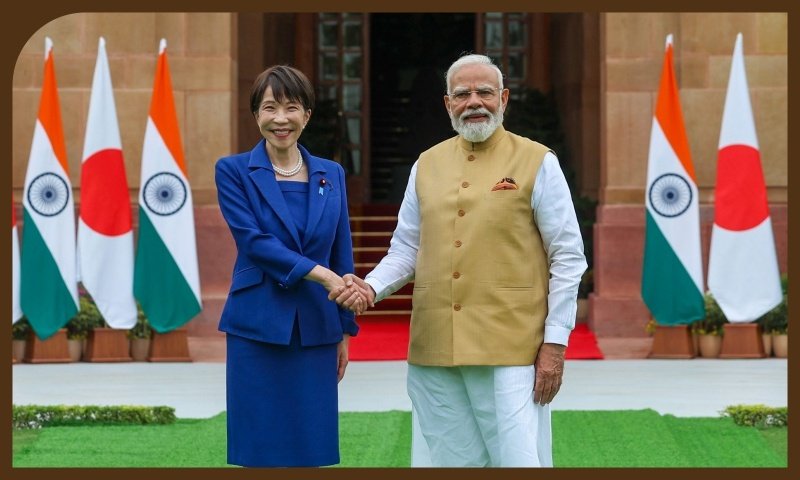
NEW DELHI — Elevating their Special Strategic and Global Partnership amid an increasingly volatile geopolitical climate, Prime Minister Narendra Modi and Japanese Prime Minister Sanae Takaichi issued a comprehensive Joint Statement following the 16th India-Japan Annual Summit held in New Delhi from July 1–3, 2026.
Marking Prime Minister Takaichi’s first official state visit to India, the two leaders formalized deep-tech, defense, and energy insulation frameworks aligned with Japan’s updated Free and Open Indo-Pacific (FOIP) vision and India’s maritime IPOI and MAHASAGAR initiatives.
1. Defense, Maritime Security, and Military Tech Co-Development
The bilateral defense alignment has officially shifted toward localized co-production under the “Make in India” framework:
-
The UNICORN Project: The leaders reached an agreement in principle on the remaining technical parameters of the Unified Complex Radio Antenna (UNICORN) naval project, clearing the path for early production.
-
Service-Level Integrations: The summit lauded the success of the “JAIMEX 25” naval exercise and Japan’s participation in the International Fleet Review 2026 in Visakhapatnam.
-
Institutional Grid: Ministers were directed to convene the fourth round of the 2+2 Ministerial Meeting in Tokyo before the end of 2026 to scale maritime domain awareness via satellites and naval Maintenance, Repair, and Overhaul (MRO) cooperation.
2. Economic Security and Diversified Supply Chains
Concurrently executing anti-coercion policies, both administrations adopted the India-Japan Joint Declaration on Economic Security Cooperation:
-
Countering Coercion: The statement voiced grave concern over non-market policies, arbitrary export curbs, and price manipulations within critical industrial sectors and critical minerals.
-
High-Tech Trade Protections: Both sides agreed to ease export control bottlenecks and maximize project-based collaboration across semiconductors, ICT, clean energy, and pharmaceuticals.
-
Capital Velocity: The leaders noted steady progress toward the 10 trillion Yen investment target, fast-tracked by the India-Japan Industrial Competitiveness Partnership (IJICP), alongside a formalized review of their 15-year-old Comprehensive Economic Partnership Agreement (CEPA).
3. Energy Resilience and Global Energy Alignment
As major energy-consuming nations, both leaders signed a Joint Statement on Energy Resilience focused on market stability and maritime chokepoint safety:
-
Chokepoint Security: Both nations explicitly opposed any restrictive measures hampering commercial vessels through critical transit corridors like the Strait of Hormuz.
-
Strategic Petroleum Reserves: Established technical collaboration and best-practice sharing on strategic stockpiling ecosystems.
-
IEA Accession: Prime Minister Takaichi formally affirmed Japan’s backing for India’s full membership in the International Energy Agency (IEA).
-
Clean Energy Scaling: Re-affirmed support for the milestone clean ammonia asset in Odisha and formalized the Cooperative Biogas for Growth (CBG) Initiative to install 1,000 biogas and organic fertilizer plants across India via dairy cooperatives.
4. Geopolitical Positioning & Multilateral Reforms
The joint statement detailed synchronized diplomatic maneuvers across regional and global theaters:
-
Counter-Terrorism Mandate: The leaders strongly condemned cross-border terrorism emanating from Pakistan, explicitly naming the 22 April 2025 Pahalgam attack, the UN Security Council Monitoring Team’s findings on The Resistance Front (TRF), and the 10 November 2025 Delhi terror incident.
-
UNSC Restructuring: Both nations pledged mutual support for permanent seats in a reformed UN Security Council, confirming a reciprocal voting arrangement for non-permanent seats for the 2028–29 and 2033–34 terms.
-
Regional Security Lines: Opposed any unilateral changes to the status quo by force or coercion in the East and South China Seas, expressed complete denuclearization mandates for North Korea, and scheduled an inaugural 1.5 track trilateral policy dialogue with the Philippines.
-
North Eastern Region (NER) Value Chains: Agreed to develop industrial value chains connecting India’s North Eastern Region with the Bay of Bengal area in coordination with BIMSTEC.
Looking Ahead
To commemorate their historical ties, both governments designated 2027—the 75th anniversary of bilateral relations—as the “India-Japan Year of Shared Horizons.” Prime Minister Modi has officially accepted an invitation to visit Japan in 2027 for the 17th Annual Summit.
