



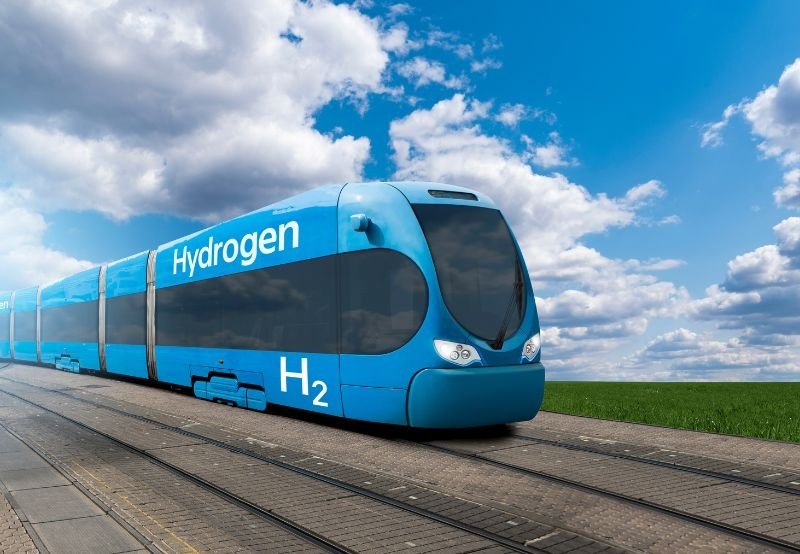
NEW DELHI — Marking a historic shift toward zero-emission mass transit, the Ministry of Railways is set to flag off India’s first Hydrogen Fuel Cell Trainset. Generating its own electricity onboard via the electrochemical reaction of hydrogen and oxygen, the cutting-edge train produces near-zero emissions at the point of use, discharging only water vapor and heat.
The rolling stock will debut on Northern Railway’s 89 km Jind–Sonipat section in Haryana, supported by India’s largest dedicated green hydrogen production and fast-refuelling railway facility at Jind.
Technical Configurations and High-Capacity Engineering
Unlike pilot projects globally that are limited to short regional routes with two or three coaches, India’s deployment scales the technology for high-volume public transport:
-
Fleet Architecture: The trainset is configured as a 10-coach passenger train consisting of two Hydrogen Driving Power Cars (DPCs) at either end and eight Trailer Coaches (TCs). It boasts a total carrying capacity of approximately 2,600 passengers.
-
Power & Performance: Each DPC houses advanced Proton Exchange Membrane (PEM) fuel cells, lithium iron phosphate (LFP) batteries, and high-pressure hydrogen cylinders, generating a combined 2,400 kW (3,200 hp). The train features a design speed of 110 kmph and will operate at a service speed of 75 kmph on the Jind–Sonipat route.
-
Indigenous Integration: The technical specifications and design approvals were formulated by the Research Designs and Standards Organisation (RDSO). The powertrain systems were integrated by Medha Servo Drives, while the Integral Coach Factory (ICF) executed the structural aesthetics and exterior design.
Multi-Layered Safety Architecture and Approvals
To manage the high flammability of hydrogen, Indian Railways implemented an internationally certified, multi-layered “defence in depth” safety system:
-
Continuous Mitigation: The train and refuelling facility are equipped with automated sensors that detect micro-leaks, heat, flames, and smoke within seconds. Continuous ventilation loops prevent gas accumulation by diluting any escape directly into the atmosphere.
-
Automatic Isolation: In the event of any system anomaly, automated shut-off valves instantly isolate the hydrogen storage tanks without requiring human intervention.
-
Global Certification: The entire hydrogen ecosystem complies with international standards (NFPA-2 and ISO 19880 series). It has cleared statutory mandates from the Petroleum and Explosives Safety Organisation (PESO) and completed independent third-party safety audits by TÜV SÜD, Germany.
The Energy Outlook: With over 99% of its Broad Gauge network already electrified, the transition to hydrogen fuel cells represents the next frontier in decarbonization for Indian Railways. By successfully establishing an integrated ecosystem—spanning local green hydrogen production via electrolysis to high-capacity rolling stock integration—India positions itself alongside Germany and China at the forefront of global clean rail propulsion, paving the way for future rollouts on iconic heritage lines like the Kalka–Shimla route.
