



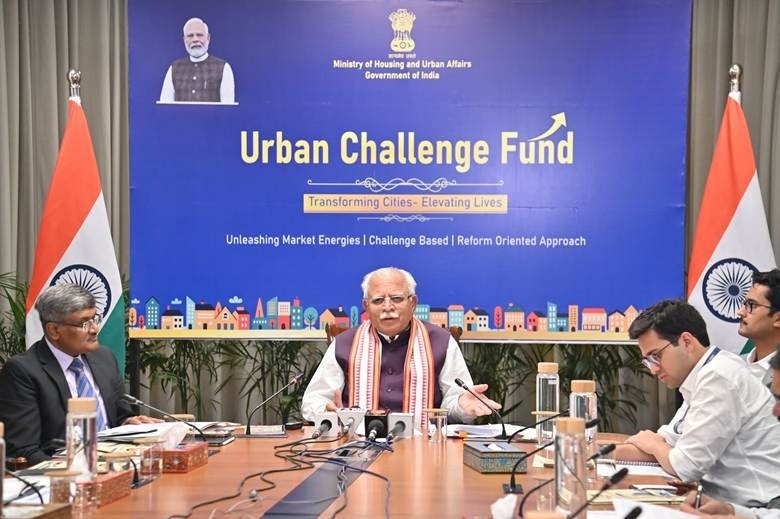
NEW DELHI – Union Minister for Housing and Urban Affairs, Shri Manohar Lal, has officially launched the operational guidelines for the Urban Challenge Fund (UCF) and the Credit Repayment Guarantee Sub-Scheme (CRGSS). This initiative aims to shift urban development from a grant-based model to a market-linked, investment-ready framework.
Financial Engineering for “Viksit Bharat”
The UCF is designed to leverage public funds to attract massive private and institutional capital, specifically targeting Tier-II and Tier-III cities.
-
Catalytic Funding: The Centre will provide ₹1 lakh crore in assistance, capped at 25% of project costs. The goal is to mobilize an additional ₹3 lakh crore (totaling ₹4 lakh crore) via municipal bonds, PPPs, and bank loans.
-
Credit Guarantee (CRGSS): A dedicated ₹5,000 crore sub-scheme will provide credit guarantees, helping smaller and hilly cities access market financing they previously could not reach.
-
Budget Allocation: Beyond the ₹90,000 crore for projects, ₹5,000 crore is earmarked for project preparation and capacity building to ensure “bankability.”
Key Sectors and Implementation
The fund will support transformative infrastructure projects from FY 2025–26 to FY 2030–31, focusing on:
-
Urban Renewal: Redevelopment of old city areas and congested markets.
-
Mobility: Last-mile connectivity and non-motorized transport.
-
Sustainability: Water, sanitation, and climate-resilient infrastructure.
Strengthening the Ecosystem
The launch featured the digital signing of MoUs with all States and the introduction of an e-directory connecting cities with credit rating agencies and financial institutions. Secretary Srinivas Katikithala noted that the fund introduces a reform-driven framework where infrastructure creation is tied strictly to financial sustainability and fiscal discipline.
By fostering collaboration between the Centre, States, and private entities, the UCF seeks to turn Indian cities into globally competitive economic hubs.
