



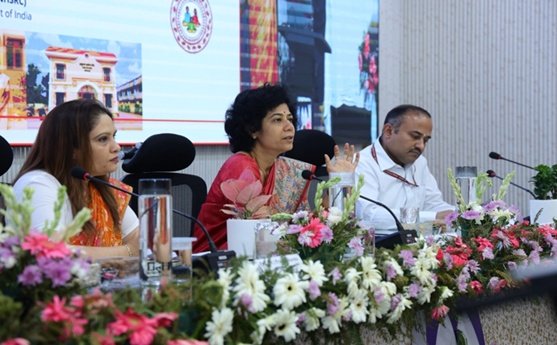
NEW DELHI — In a major initiative to upgrade India’s frontline healthcare ecosystem, the Union Ministry of Health and Family Welfare (MoHFW) successfully concluded a two-day National Training of Trainers (NToT) at the National Health Systems Resource Centre (NHSRC), New Delhi.
The apex program trained over 110 National and Master Trainers to overhaul capacity-building across all five core cadres delivering comprehensive primary healthcare at Ayushman Arogya Mandirs (AAMs).
1. Decentralized Rollout Strategy
Presiding over the inaugural session, Smt. Aradhana Patnaik, Additional Secretary and Mission Director of the National Health Mission (NHM), outlined a clear implementation timeline:
-
Cascade Implementation Mode: Following the national-level training of master trainers, the program will be scaled across the country through more than 100 designated Regional Training Institutes starting in August 2026.
-
Quality Certification & Trust: The decentralized model is aimed at standardizing workforce skills to secure formal quality certifications for public facilities, thereby strengthening community trust in state-sponsored healthcare.
-
Inter-Agency Convergence: The rollout emphasizes closer integration across distinct health programs and institutional alignment with Mission Karmayogi Bharat (MKB) to maximize service delivery.
2. Shift to a Patient-Centric, Competency-Based Framework
The NToT implements the Integrated Training Strategy (ITS) and cadre-specific training modules originally launched by Union Health Minister Shri Jagat Prakash Nadda at the National Summit on Best Practices in Chandigarh on April 30, 2026.
The strategy marks a deliberate transition from rigid, program-specific knowledge retention to a patient-centric, competency-based framework. It establishes uniform training standards for five critical frontline positions:
-
Medical Officers
-
Staff Nurses
-
Community Health Officers (CHOs)
-
Auxiliary Nurse Midwives (ANMs)
-
Accredited Social Health Activists (ASHAs)
“Technical knowledge alone is not sufficient. There is an urgent need to incorporate behavioural competencies, deep empathy, and effective communication into health workforce training to ensure people-centred and compassionate care.” — Smt. Aradhana Patnaik, Additional Secretary & MD (NHM)
3. Immersive Curriculum at NIHFW Skill Lab
The training curriculum combined structured classroom lectures, case-based clinical discussions, and hands-on practical simulations executed at the specialized NIHFW Skill Lab (National Institute of Health and Family Welfare).
By balancing hard technical protocols with essential soft-skill training, the framework equips trainers with the tools needed to retrain frontline workers in managing complex, evolving community health burdens effectively.
4. Institutional Presence
The high-level gathering was attended by top policymakers, regulatory representatives, and healthcare administrators, including:
-
Shri Sibin C (Joint Secretary, Policy, MoHFW)
-
Prof. (Dr.) Pragya Sharma (Executive Director, NHSRC)
-
Senior representatives from the Directorate General of Health Services (DGHS)
-
Officials from the National Medical Commission (NMC)
-
Leadership from Mission Karmayogi Bharat (MKB)
