



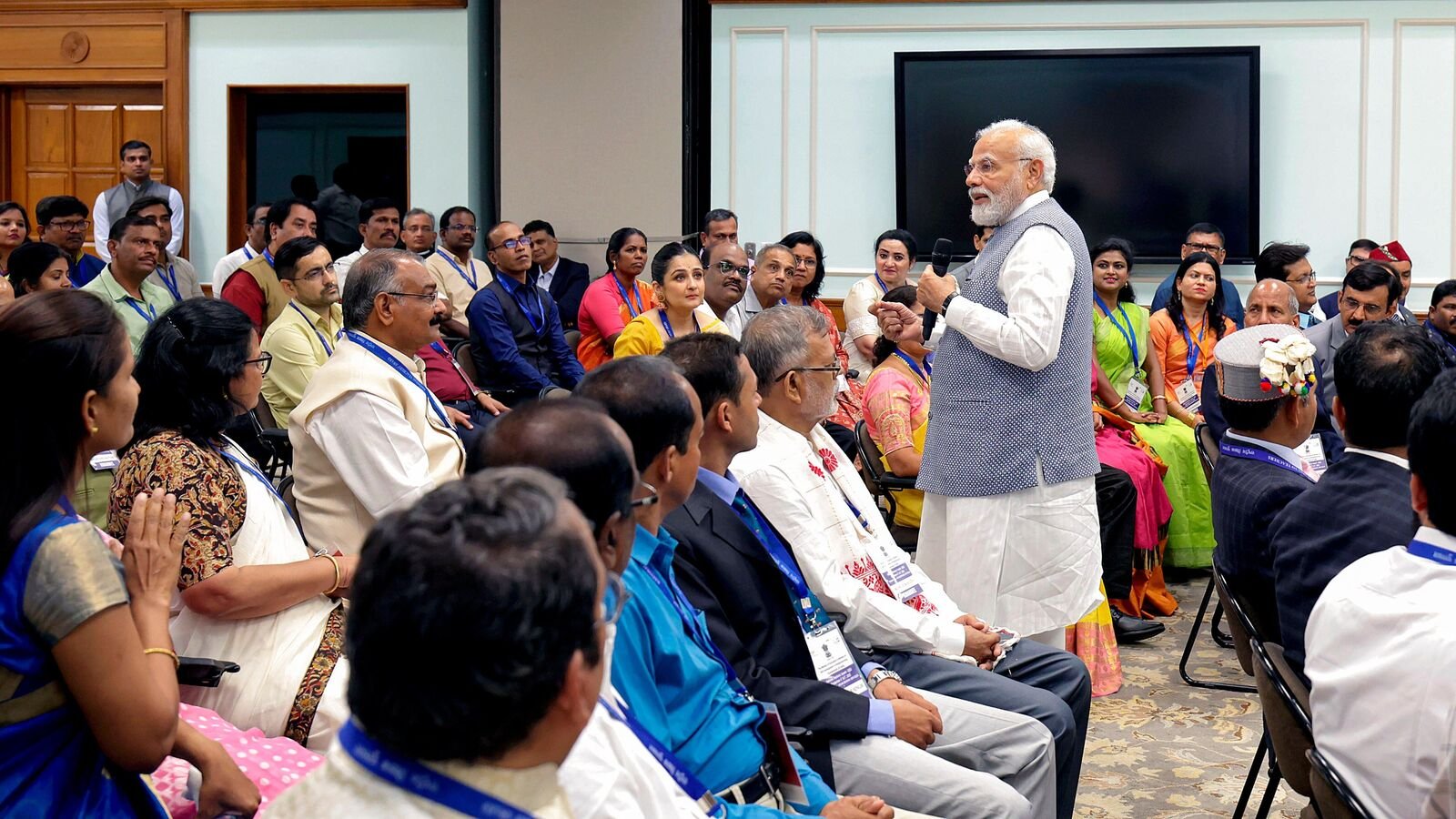
NEW DELHI — Prime Minister Narendra Modi hosted the 82 recipients of the National Teachers’ Awards 2026 at his official residence on Lok Kalyan Marg, outlining key institutional guidelines on student welfare, digital addiction, and experiential pedagogy under the National Education Policy (NEP).
The delegation represented exceptional educators selected across primary, higher, and vocational education sectors, recognized for deploying creative instructional methodologies and administrative innovations in classroom environments.
Sectoral Award Allocations & Operational Framework
-
Total Awardees: 82 teachers, higher education faculty, and vocational skill trainers across three central ministries/departments.
-
Departmental Breakdown:
-
School Education & Literacy: 48 teachers from primary, middle, and secondary institutions.
-
Higher Education & Polytechnics: 21 faculty members and technical educators.
-
Skill Development & Entrepreneurship: 13 certified skill trainers.
-
-
Institutional Venue: Lok Kalyan Marg, New Delhi.
Prime Minister’s Directive & Policy Focus Areas
-
Mitigating Youth Substance Abuse: Instructed educators to maintain heightened vigilance regarding behavioral changes in students to detect early signs of drug addiction, mandating active institutional support and counseling to facilitate recovery.
-
Addressing Excessive Screen Time: Highlighted rising screen exposure among children as a critical public health and developmental challenge. Urged educators to partner with parents to monitor late-night device usage and channelize student engagement toward physical sports, outdoors, and creative arts.
-
Preserving Student Curiosity: Emphasized the role of teachers in safeguarding childhood innocence and nurturing natural inquiry, advising that structured channelization of curiosity drives long-term cognitive development.
-
Value-Based & NEP-Aligned Pedagogy: Called for full alignment with National Education Policy principles by transitioning beyond rote syllabus delivery. Advised educators to incorporate real-world skills, field exposure, and foundational values such as the dignity of labor into standard curricula.
