



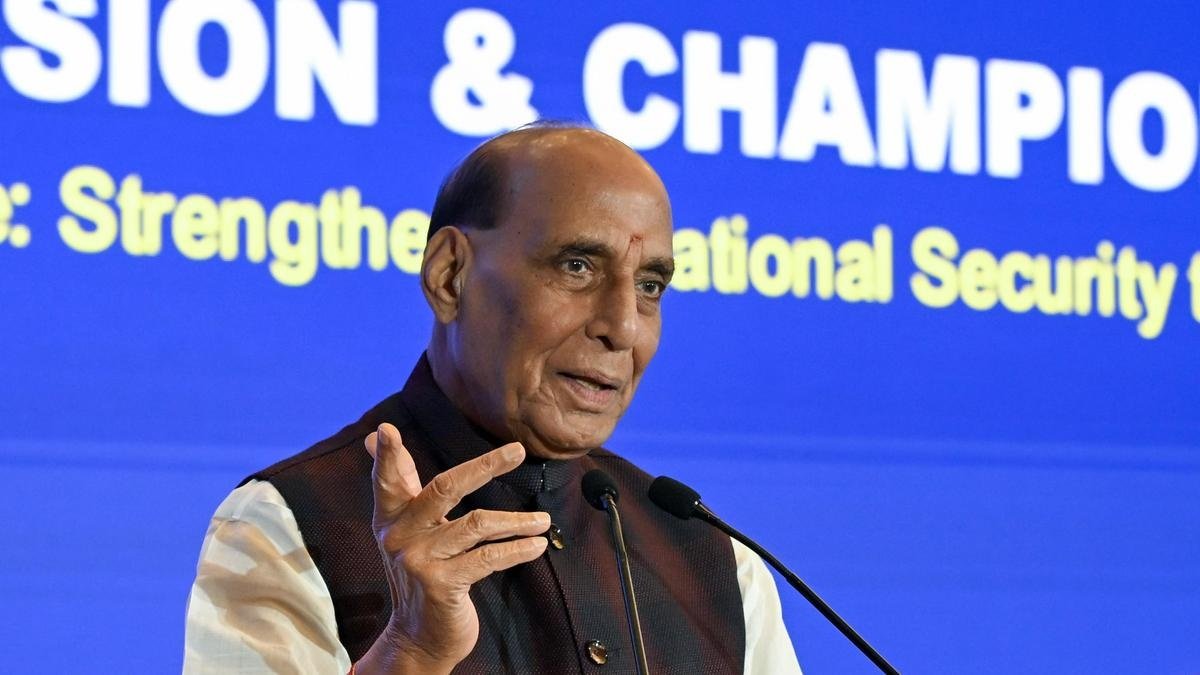
NEW DELHI — Elevating the organization’s legacy beyond bureaucratic definitions, Defence Minister Rajnath Singh characterized the Rashtriya Swayamsevak Sangh (RSS) as an enduring “civilizational force that needs no certification or validation.”
The Defence Minister delivered his remarks at Uprashtrapati Bhavan during the unveiling of the commemorative book RSS@100: A Century of Service, Unity & Sacrifice, co-authored by Shyam Jaju and Anupam Trivedi. The milestone event was attended by Vice President CP Radhakrishnan, Delhi Assembly Speaker Vijender Gupta, and other prominent national figures.
Countering Opposition Scrutiny via Constitutional and Natural Axioms
Responding to statements from senior Congress leaders challenging why the RSS remains unregistered, the Defence Minister dismissed the critiques as completely groundless:
-
The Metaphorical Shield: Singh highlighted that fundamental forces are self-evident, stating, “A mother’s love requires no license. The values instilled by a Guru do not depend on a government seal… The sun requires no registration to radiate light. Similarly, the RSS is a civilizational force.”
-
Constitutional Standing: He clarified that the Constitution of India explicitly guarantees the fundamental right to form associations, rendering targeted political queries on the organization’s status structurally redundant.
-
Unrivaled Stability: Singh underscored the Sangh’s status as a global anomaly—a massive voluntary collective that has operated continuously for a century without experiencing a single internal split, guided by an ethos of selfless service over personal fame.
Archiving History: Border Integration and Democratic Defense
The address placed a heavy emphasis on preserving the historical contributions of RSS volunteers for the nation’s youth:
-
Sovereign Flashpoints: The Defence Minister cited critical historical interventions, including MS Golwalkar’s pivotal 1947 mission to persuade Maharaja Hari Singh to sign Kashmir’s accession to India, alongside volunteer roles in the 1954 liberation of Dadra and Nagar Haveli and the liberation of Goa.
-
Shielding Civil Liberties: Singh detailed the RSS’s record as a frontline guardian of civic freedoms, pointing to its early opposition to free speech suppression in 1950 and its extensive underground leadership during the 1975 Emergency to restore constitutional democracy.
The Centenary Roadmap: Core Pillars for an Advanced Nation
As the organization marks 100 years since its founding by Dr. Keshav Baliram Hedgewar in 1925, its leadership has actively rejected superficial celebrations in favor of deep structural introspection:
-
The ‘Panch Pran’ Pledges: Marking the centenary milestone, the RSS has formally adopted Five Pledges (Panch Pran) geared toward fostering a value-driven, self-reliant, duty-bound, and environmentally conscious populace.
-
A Century of Self-Reliance: Singh concluded that the small seed planted in 1925 has expanded into the world’s largest, financially self-sufficient voluntary movement, with its newly enacted Panch Pran framework serving as the functional roadmap to build a fully developed India.
