



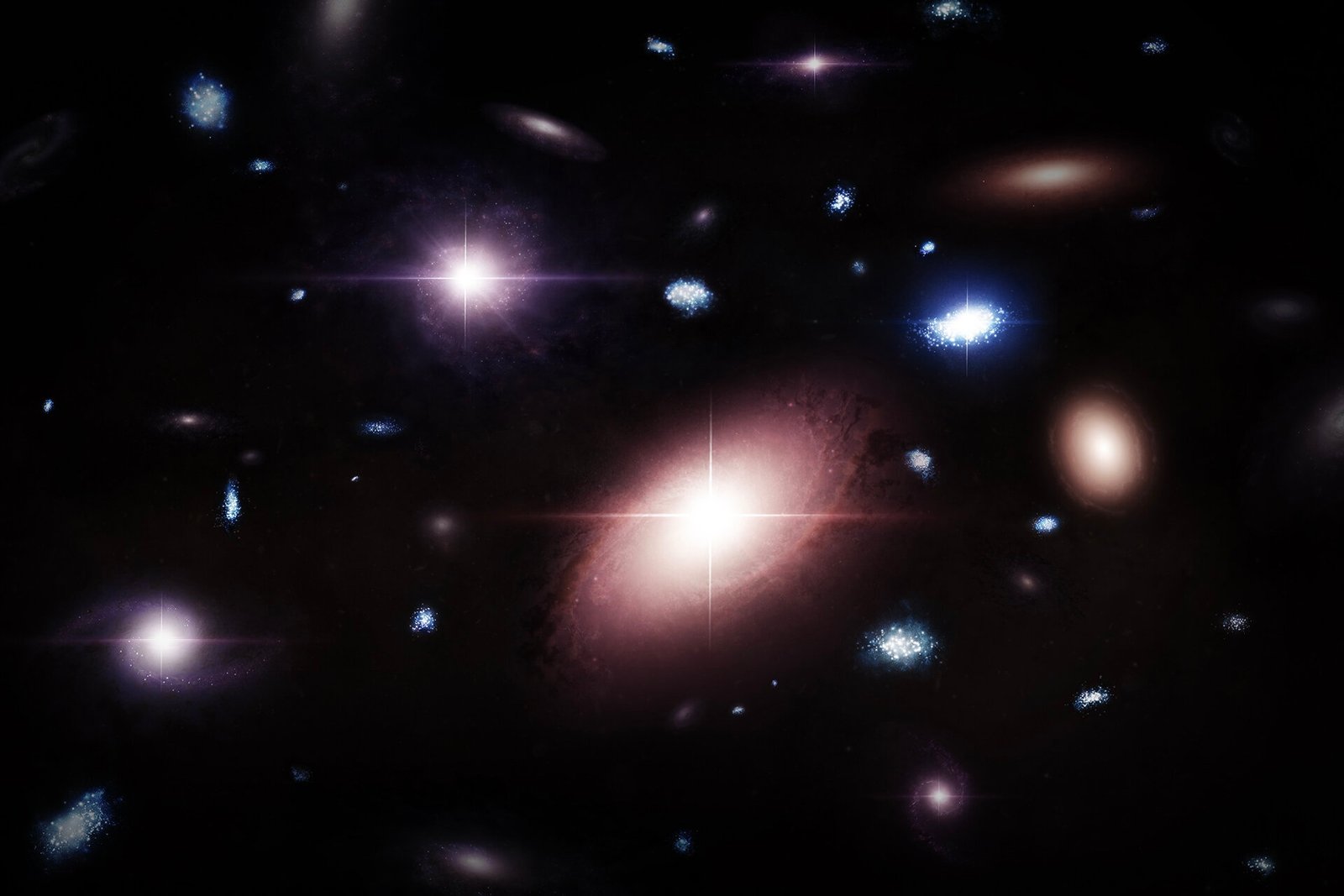
NEW DELHI — Researchers from the Indian Institute of Astrophysics (IIA) have made a breakthrough in understanding the cosmic “missing link” between small galaxies and black holes. A new study by K. Aditya and Arun Mangalam probes whether dwarf spheroidal galaxies—the tiny, faint neighbors of our Milky Way—host central black holes.
By creating advanced dynamical models, the team has successfully extended the famous black hole mass – stellar velocity dispersion relation down to the smallest known scales, covering seven orders of magnitude in black hole mass.
The Scientific Challenge
Unlike massive galaxies, dwarf galaxies are “gas-poor” and dominated by dark matter, making it nearly impossible to “see” a black hole. The researchers used stellar anisotropy—modeling how stars move in different directions—to set limits on how heavy a central black hole could be.
Key Findings:
-
Mass Limits: Most dwarf galaxies likely host Intermediate-Mass Black Holes (IMBHs), with masses typically below one million solar masses (rather than the multi-billion solar mass giants in large galaxies).
-
Unified Scaling: The study proves that the same mathematical law governing black hole growth in giant galaxies also applies to these tiny dwarfs.
-
Growth Mechanisms: The team compared their data to models of stellar capture (black holes “eating” nearby stars) and momentum-driven gas accretion, finding both could explain black hole presence in low-mass environments.
Why It Matters
Establishing this unified relation provides a critical benchmark for cosmic evolution. It helps scientists understand if these black holes are “seeds” from the early universe or the remains of larger galaxies that were stripped of their stars by the Milky Way’s gravity.
Looking Ahead
This research sets the stage for future mega-telescopes like India’s proposed National Large Optical Telescope (NLOT) and the Extremely Large Telescope (ELT). These facilities will have the power to look deep into these faint galaxies and directly confirm if these “primordial seeds” truly exist.
