



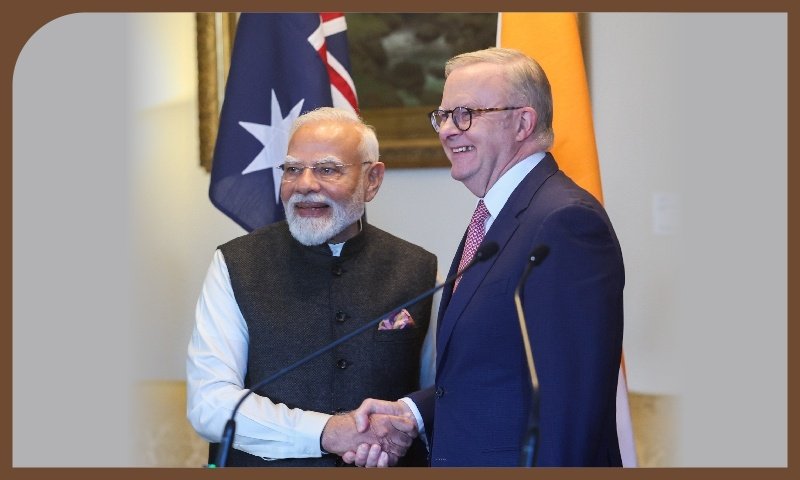
CANBERRA / NEW DELHI — Moving decisively past diplomatic pleasantries, the Prime Minister of India’s high-profile visit to Australia has concluded with a sweeping slate of operational pacts that fundamentally upgrade the strategic architecture of the Indo-Pacific.
From unlocking Australian uranium exports to establishing physical Australian university campuses on Indian soil, the outcomes of this summit mark a massive shift toward deep institutional integration.
The Security Matrix: Upgrading Defense and Maritime Dominance
The cornerstone of the visit is the new Joint Declaration on Defense and Security Cooperation (JDDSC). Replacing a legacy 2009 framework, this upgraded treaty explicitly targets military interoperability, cyber warfare, and critical technology defense, while enforcing a unified stance on UNCLOS maritime laws across the ASEAN and Indian Ocean regions.
To turn policy into real-time deterrence, the two nations launched the Maritime Security Collaboration Roadmap (MSCR) for streamlined intelligence sharing. This is backed by an operational MoU between the Indian Coast Guard (ICG) and Australia’s Maritime Border Command (MBC).
Further cementing institutional trust, Australia has formally invited an Indian military instructor to join the faculty at the Australian Defense College for the 2028–29 academic year.
The Energy Pivot: Uranium Supply and Solar Scaling
In a major geopolitical breakthrough, officials finalized the Administrative Arrangement of the India-Australia Civil Nuclear Agreement. This critical step operationalizes a 2014 framework, officially clearing the path for Australia to export uranium to India to fuel its zero-emission energy transition.
Recognizing the fragility of global grids, both nations signed a Joint Statement on Energy Security to shield supply chains from geopolitical friction. On the grassroots front, the partners operationalized the Rooftop Solar Training Academy in Gandhinagar. Aligned with India’s PM Surya Ghar Yojana, the academy is locked in to train 2,000 women and youth as specialized solar technicians.
Bricks and Mortar: Australian Universities Land in India
The summit took a sledgehammer to traditional educational barriers, transitioning from simple student exchanges to physical, structural integration:
-
Flinders University handed over its Letter of Intent to establish a permanent campus in Bengaluru.
-
Victoria University secured official approval to build and operate its campus in Gurugram.
-
A major regulatory pact between India’s NCVET and the Australian Skills Quality Authority (ASQA) will cross-align vocational standards to make workforce qualifications mutually recognizable.
-
Western Australia’s TAFE partnered with India’s Skill Ministry to launch a Centre of Excellence in Mining and METS in Bhubaneswar, enabling direct, cross-border trainee exchanges.
Tech Frontiers and Critical Mineral Resiliency
Addressing modern economic vulnerabilities, the newly launched Australia-India Partnership for Cyber, Critical Technologies, and Supply Chains (PACTS) will build regional resilience against digital threats.
Simultaneously, GeoScience Australia and the Geological Survey of India (GSI) inked an infrastructure modernization deal to introduce advanced exploration methodologies in the hunt for critical minerals. Trilateral technology ecosystems were also expanded via the Australia-Canada-India (ACITI) Partnership.
Restoring Heritage, Binding Science and Art
In a profound cultural milestone, Australia officially repatriated three rare, centuries-old antiquities stolen from Tamil Nadu:
-
An 11th-to-12th-century granite sacred bull Nandi
-
An 11th-century bronze Trident with Auspicious Kali
-
A 12th-century basalt sculpture of the six-headed Skanda (Karttikeya)
On the scientific and creative front, India’s CSIR opened access to its Traditional Knowledge Digital Library (TKDL) to IP Australia to protect indigenous data. CSIR also locked in a biomedical research pact with the University of Melbourne for drug target identification. Meanwhile, the Satyajit Ray Film and Television Institute (SRFTI) in Kolkata teamed up with Brisbane’s Griffith Film School to launch joint cinematic projects and summer workshops.
The Big Picture: Rather than relying on vague diplomatic alignment, New Delhi and Canberra have built an interconnected web of nuclear energy, physical campus investments, and joint maritime enforcement—solidifying a highly operational, long-term alliance.
