



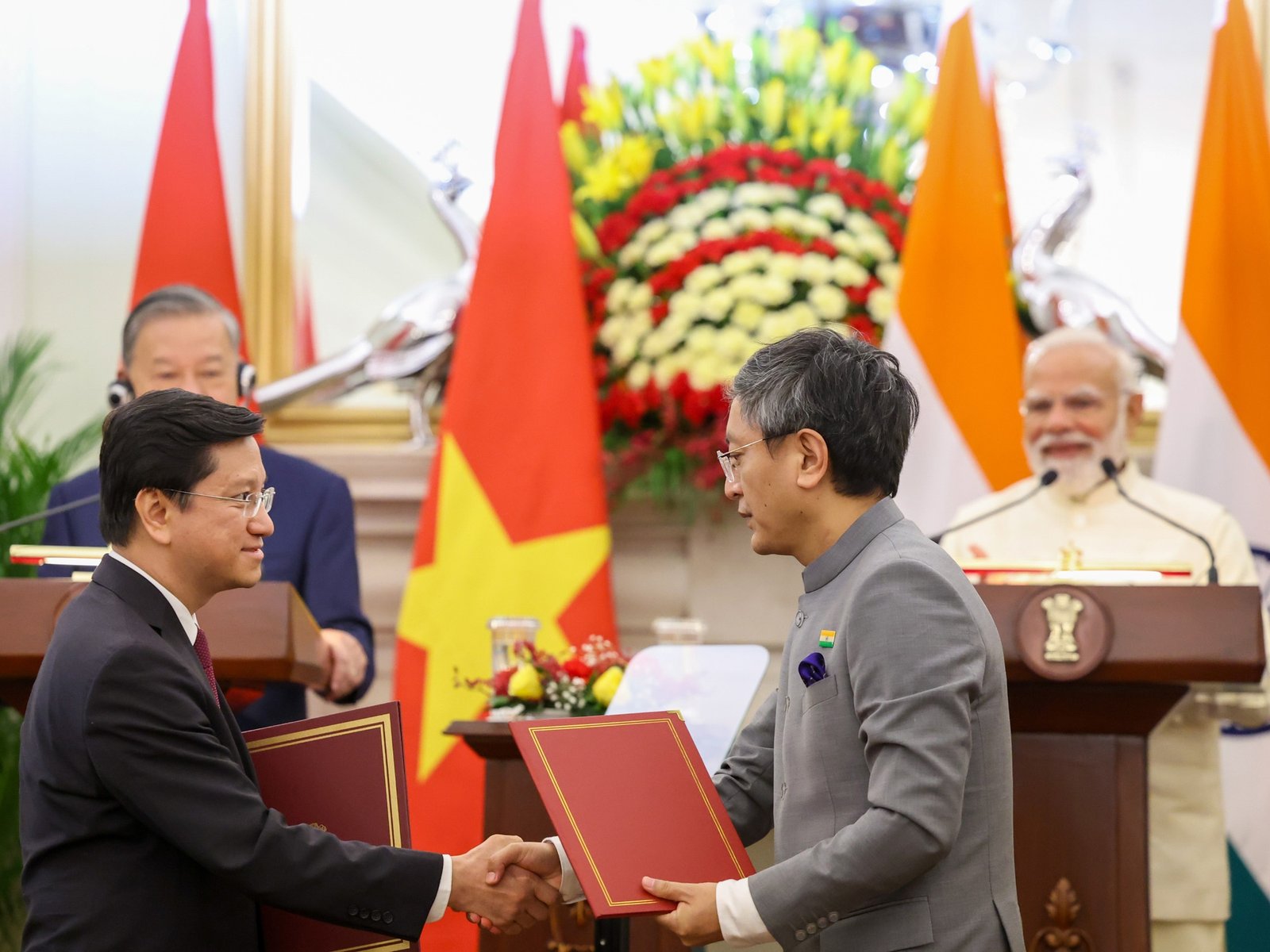
NEW DELHI — In a historic diplomatic milestone, India and Vietnam have officially elevated their relationship to an “Enhanced Comprehensive Strategic Partnership.” This decision was formalized during the State Visit of Vietnamese President and General Secretary To Lam to India from May 5–7, 2026, marking a new chapter of “shared vision and strategic convergence.”
1. Economic & Trade: The $25 Billion Goal
Recognizing their roles as two of Asia’s fastest-growing economies, Prime Minister Narendra Modi and President To Lam set an ambitious new bilateral trade target of $25 billion by 2030.
-
Market Access: India will now import Vietnamese Durians and Pomelos, while Vietnam will open its doors to Indian Grapes and Pomegranates.
-
Supply Chains: Both nations agreed to diversify supply sources in high-tech manufacturing, EVs, and semiconductors.
2. Defense & Security: A Key Pillar
Defense remains the bedrock of this partnership, guided by the “Joint Vision Statement 2030.”
-
Hydrographic Cooperation: Following the first joint survey in May 2025, regular exercises will now be a fixture off the Vietnamese coast.
-
Strategic Dialogue: The leaders announced a new “2+2” Strategic Diplomacy – Defence Dialogue.
-
Maritime Security: India invited Vietnam to station a Liaison Officer at the Information Fusion Centre (IFC-IOR) in Gurugram to boost real-time maritime awareness.
3. Energy, Technology, and Space
-
Oil & Gas: India’s involvement in exploration in the South China Sea (consistent with UNCLOS) will be expanded.
-
Nuclear & Rare Earths: A new MoU on Rare Earths was signed between India’s IREL and Vietnam’s VINATOM. India also welcomed Vietnam’s invitation to participate in its nuclear power sector.
-
Digital Finance: The RBI and State Bank of Vietnam signed an MoU to link retail payment platforms (QR codes) to facilitate seamless tourism and business transactions.
4. Cultural & Civilizational Bonds
-
Holy Relics: Vietnam expressed gratitude for the exposition of the Holy Relics of Lord Buddha in 2025, which saw an overwhelming public response.
-
Preservation: India will continue the restoration of the My Son UNESCO World Heritage Site and other heritage towers in Vietnam.
-
Tourism: A new Cultural Exchange Programme (2026–2030) was signed to boost “Buddhist Circuit” tourism for Vietnamese pilgrims.
5. Geopolitics: South China Sea & ASEAN
The joint statement sent a clear signal on regional stability:
-
South China Sea: Both leaders emphasized a free, open Indo-Pacific and insisted that disputes must be settled according to UNCLOS 1982, without the threat or use of force.
-
UNSC Reform: Vietnam reaffirmed its strong support for India’s permanent membership in a reformed UN Security Council.
Key Outcomes at a Glance
| Sector | Major Announcement |
| Partnership Level | Elevated to Enhanced Comprehensive Strategic Partnership |
| Trade Target | $25 Billion by 2030 |
| Institutional | Establishment of Strategic 2+2 Dialogue |
| Connectivity | Linkage of QR-based digital payment systems |
| Maritime | Joint Hydrographic Surveys and IPOI-AOIP synergy |
The visit concludes with an invitation from President To Lam for Prime Minister Modi to visit Vietnam, underscoring the “thousand-year history” and the bright future of this Indo-Pacific alliance.
