



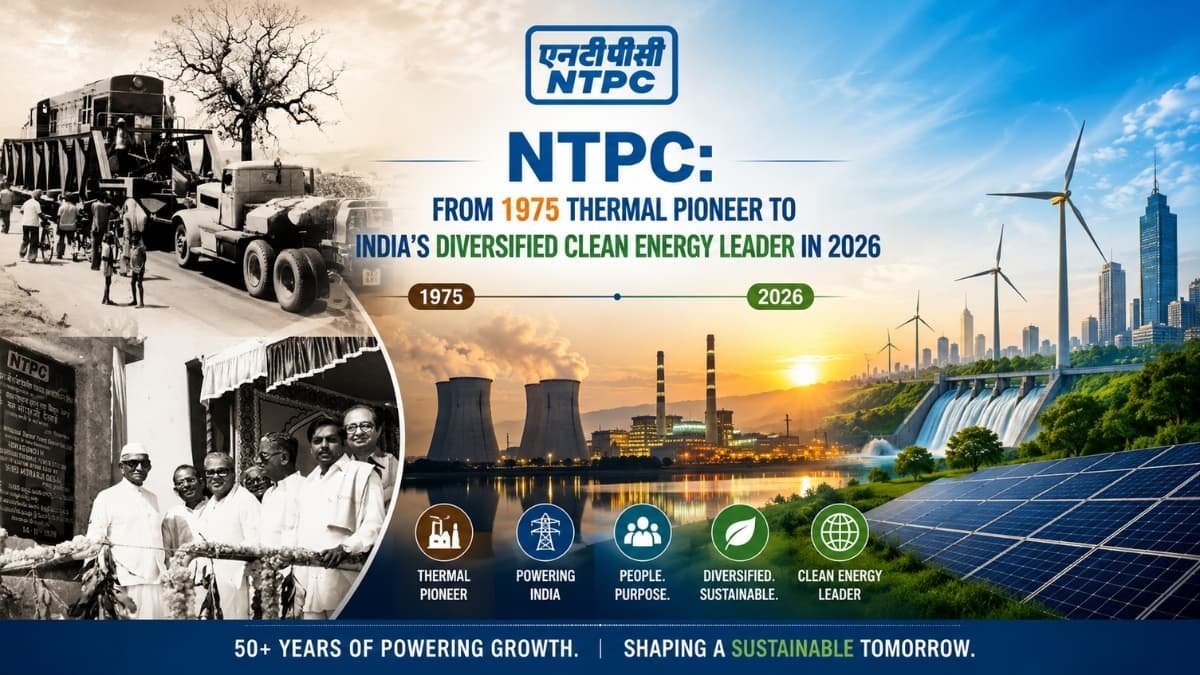
NEW DELHI — In a major milestone for India’s energy transition, state-run power giant NTPC Limited has officially crossed 90,000 MW of installed capacity, solidifying its position as the nation’s premier power utility while aggressively pivoting toward a green energy future.
As of mid-2026, the Maharatna conglomerate commands a massive 90,807.20 MW of installed capacity. This single enterprise now accounts for roughly 17% of India’s national capacity and generates a staggering 24% of the country’s total electricity, driven by operational efficiencies that consistently outperform the national average.
Efficiency Premium Sustains Market Dominance
NTPC’s legacy thermal fleet continues to serve as the backbone of India’s grid reliability. For nearly two decades, the company has maintained a “performance premium” of 6% to 12% above the all-India coal and lignite Plant Load Factor (PLF).
In the financial year 2025–26, the utility achieved a highly resilient 72% PLF across its standalone coal assets, recovering strongly by roughly 9% from post-pandemic lows. This baseline efficiency secured NTPC the global top rank among Independent Power Producers (IPPs) and Energy Traders in the S&P Global Commodity Insights rankings.
The Current Mix: March 2026 Breakdown
The total group capacity of 90,807.20 MW is divided between direct ownership and expanding subsidiaries:
-
NTPC Owned (60,950.40 MW across 54 plants):
-
Coal: 54,750 MW (27 plants)
-
Gas & Liquid Fuel: 4,017 MW (7 plants)
-
Solar PV: 1,375.40 MW (18 plants)
-
Hydro: 800 MW (1 plant)
-
-
Joint Ventures & Subsidiaries (29,856.80 MW): Driven by massive contributions from NEEPCO, THDC, and the rapidly growing NTPC Green Energy Limited (NGEL).
Beyond its pan-India footprint, NTPC is establishing a prominent regional footprint with an international operational portfolio of 1,320 MW.
The 2032 Blueprints: Target 149 GW
The company is aggressively restructuring its long-term portfolio to meet its formal Energy Compact Goals. By 2032, NTPC aims to expand its total footprint to 149 GW, fundamentally changing how its capacity is distributed.
| Energy Source | Target Capacity by 2032 | Projected Share (%) |
| Thermal (Coal/Gas) | 83.6 GW | 56.11% |
| Renewable Energy | 60.0 GW | 40.27% |
| Hydro | 4.7 GW | 3.15% |
| Nuclear | 0.7 GW | 0.47% |
This expansion roadmap pushes the non-fossil fuel share to approximately 44% of the company’s total footprint. To support the intermittent nature of its targeted 60 GW renewable expansion, NTPC is building a robust storage pipeline featuring 1 GW of Pumped Storage and 22 GWh of Battery Energy Storage Systems (BESS).
Atomic Ambitions and Corporate Financial Might
To secure reliable baseline power without the associated carbon footprint, NTPC is formally expanding into nuclear energy. Through ASHVINI, a 49:51 joint venture with the Nuclear Power Corporation of India Limited (NPCIL), the company is executing the 2,800 MW Mahi Banswara atomic project in Rajasthan. Looking further ahead, a wholly owned subsidiary—NTPC Parmanu Urja Nigam Ltd. (NPUNL)—has been structured to spearhead a long-term goal of 30 GW of nuclear capacity by 2047.
This capital-intensive pivot is backed by a powerhouse balance sheet. Over the last 25 years, NTPC’s annual revenue has surged past ₹1,88,138 crore, while total corporate assets have expanded nearly 15-fold to ₹5,24,165 crore.
A key catalyst for this fiscal growth has been strategic corporate unbundling. The successful public listing of NTPC Green Energy Limited (NGEL) on the NSE and BSE in 2024 unlocked massive market value, complementing standalone arms like NVVN (power trading) and NTPC Mining Limited.
The Road Ahead
With 18,101 MW of thermal and hydro capacity currently under construction alongside 14,410 MW of active renewable project pipelines, the utility is navigating a unique dual-track strategy. By preserving its ultra-efficient baseload coal infrastructure while simultaneously building massive economies of scale across solar, wind, storage, and nuclear power, NTPC is solidifying its role as the primary guarantor of India’s long-term energy security.
