



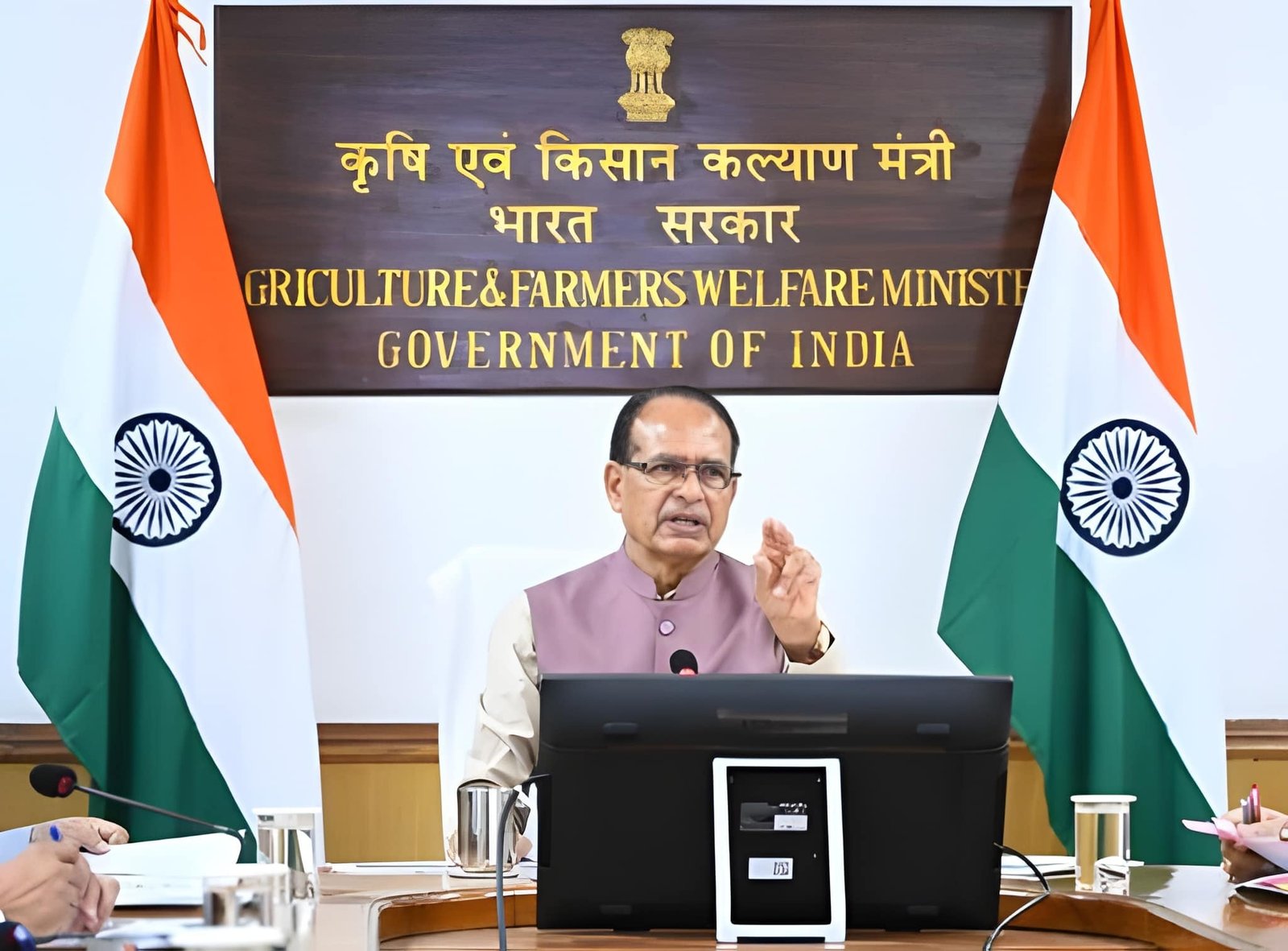
NEW DELHI — Preparing the country’s agricultural sector for potential weather anomalies, Union Minister for Agriculture and Farmers’ Welfare, and Rural Development, Shri Shivraj Singh Chouhan, chaired a high-level weekly review meeting at Krishi Bhavan. The primary mandate of the session was to fortify India’s food security and farming infrastructure ahead of the Kharif 2026 season against potential El Niño disruptions.
The ministry rolled out a multi-pronged mitigation matrix targeting district-level contingency planning, localized fertilizer buffer stocks, mission-mode cotton cultivation, and aggressive domestic pulse production.
Decentralized El Niño Strategy and Water Management
Acknowledging the threat of deficient or uneven monsoon distribution, the Minister outlined a highly localized response mechanism to protect farm incomes:
-
District-Specific Blueprints: The Ministry has earmarked 9 to 10 states expected to bear a disproportionate impact of El Niño. Chouhan directed immediate coordination meetings involving District Magistrates, state agriculture departments, and Krishi Vigyan Kendras (KVKs) to draft micro-level alternative crop patterns.
-
Aggressive Extension Campaigns: Extension networks have been instructed to pass calm, scientifically sound, and solution-oriented advisories to farmers regarding moisture conservation, mulching, water preservation, and inter-cropping techniques, steering clear of alarmist messaging.
-
Fertilizer Logistics: Asserting that aggregate national fertilizer availability remains robust, Chouhan ordered officials to map out micro-level demand spikes. Supply chains will be accelerated in tandem with the monsoon’s progression to prevent localized artificial deficits or black-marketing.
Production Directives: Mission-Mode Cotton and Pulses Self-Reliance
Beyond weather mitigation, the review session laid down aggressive production benchmarks for specific commercial and food crops to insulate domestic markets:
-
Mission-Mode Cotton Push: To maximize yield and lint quality this season, the Minister ordered a mission-mode drive focused on the propagation of scientific sowing methods, premium seed varieties, and advanced moisture-retention protocols to boost net farmer returns.
-
The Pulses Self-Reliance Mandate: In alignment with the Atmanirbhar Bharat vision, the Self-Reliance in Pulses Mission received a major strategic push. The government will coordinate with state machineries to scale up the acreage of pigeon pea (arhar), black gram (urad), and moong. The strategy relies on expanding crop cycles, improving certified seed availability, and offering technical handholding to systematically erase India’s dependence on pulse imports.
The Integration Mandate: Emphasizing that high-tech research must translate directly to field-level results, Chouhan called for seamless data and communication integration between the Indian Council of Agricultural Research (ICAR), agricultural universities, and ground-level extension workers to safeguard the Kharif 2026 harvest.
