



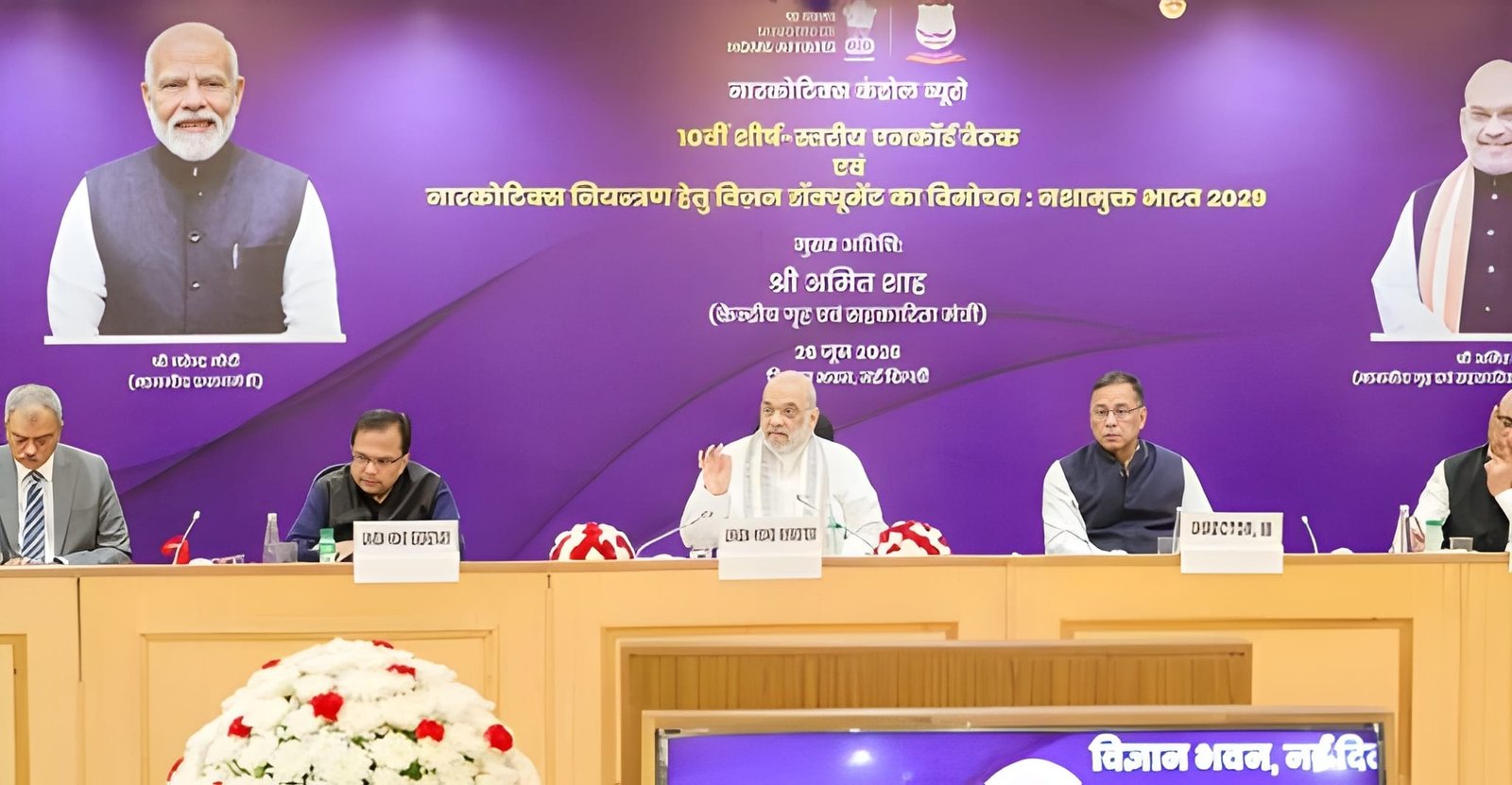
NEW DELHI — In a major escalation of India’s internal security strategy, Union Home Minister and Minister of Cooperation Shri Amit Shah chaired the 10th apex-level meeting of the Narco-Coordination Centre (NCORD) today.
Declaring the next three years as the decisive window to achieve a Nasha Mukt Bharat (Drug-Free India), the Home Minister unveiled the statutory ‘Vision Document on Drug Control (2026-2029)’ alongside the ‘NCB Annual Report – 2025’. To strengthen operational infrastructure, he also virtually inaugurated new Narcotics Control Bureau (NCB) Zonal Offices in Jammu and Guwahati, and launched a massive ‘Online Drugs Disposal Fortnight Campaign’ targeting the destruction of 2,09,500 kilograms of seized contraband valued at over ₹6,000 crore.
The Strategy: Detect, Disrupt, and Destroy
The Home Minister emphasized that the modern narcotics trade has evolved into a highly complex, technology-driven multi-domain crime, heavily tied to cross-border narco-terrorism, Darknet markets, drone drops, and cryptocurrency payments.
To counter this ecosystem, the Ministry of Home Affairs (MHA) has directed enforcement agencies to operate strictly under a tripartite directive:
-
Detect: Leveraging a blend of Human Intelligence (HUMINT), advanced technical surveillance, and community policing to trace cartels from initial production borders down to village-level distribution networks.
-
Disrupt: Mandating ruthless financial crackdowns. State Police Chiefs must now make financial investigations through the Enforcement Directorate (ED) and Prevention of Money Laundering Act (PMLA) mandatory in all major commercial cases to freeze the proceeds of crime permanently.
-
Destroy: Dismantling syndicates entirely so they cannot recover. This includes utilizing the CBI to issue Red Corner Notices and launch aggressive extradition processes against drug lords hiding overseas.
“We must adopt a ruthless approach towards drug traffickers while maintaining a sympathetic approach towards the affected youth,” Shah asserted. “Under the leadership of Prime Minister Shri Narendra Modi, we will strike the entire drug trade ecosystem so decisively over the next three years that it will not be able to recover for decades.”
Operational Architecture: The Four Pillars
The newly launched 2026-2029 roadmap relies heavily on a structured, pan-government framework built upon four foundational pillars, monitored via strict, time-bound deliverables:
| Strategy Pillar | Key Objectives & Directives |
| Enforcement & Intelligence | Transform state Anti-Narcotics Task Forces (ANTFs) into dedicated, full-time units; utilize intelligence nodes like NATGRID and I4C for high-level cartel tracking. |
| Precursor & Synthetic Control | Enforce strict monitoring of online pharmacies and chemical diversions via the Ministry of Health; review schedules of psychotropic substances. |
| Demand & Harm Reduction | Establish localized ‘Drug-Free Zones’ and scale rehabilitation setups through the Ministry of Social Justice and Empowerment. |
| Capacity & Coordination | Establish exclusive, fast-track NDPS courts within state High Courts to ensure speedy judicial convictions. |
Comparative Progress: A Decade of Enforcement Data
Highlighting a significant spike in operational efficiency and enforcement over the past twelve years, Shah provided comparative institutional data reflecting the aggressive scale-up in drug seizures and crackdowns:
-
Contraband Seizures: Between 2004 and 2014, authorities seized drugs worth ₹40,000 crore (26 lakh kg). Conversely, from 2014 to 2026, total seizures rose drastically to ₹1,84,000 crore (1.18 crore kg).
-
Narcotics Destruction: Drug disposal skyrocketed from ₹8,000 crore (3.26 lakh kg) in the 2004-2014 period to ₹89,896 crore (42.47 lakh kg) between 2014 and 2026.
-
Criminal Arrests: Total cases registered surged from 1.73 lakh (yielding 1.95 lakh arrests) in the previous decade to 8.75 lakh cases and 10.97 lakh arrests between 2014 and 2026.
-
Crop Eradication: Destructive campaigns targeting illegal opium cultivation expanded from 10,000 acres in 2020 to 42,282 acres destroyed in 2025 alone.
The meeting concluded with a strong call to action for all state Chief Secretaries and Directors General of Police (DGPs) to move away from routine administrative oversight and turn state-level NCORD meetings into highly localized, result-oriented enforcement actions.
