



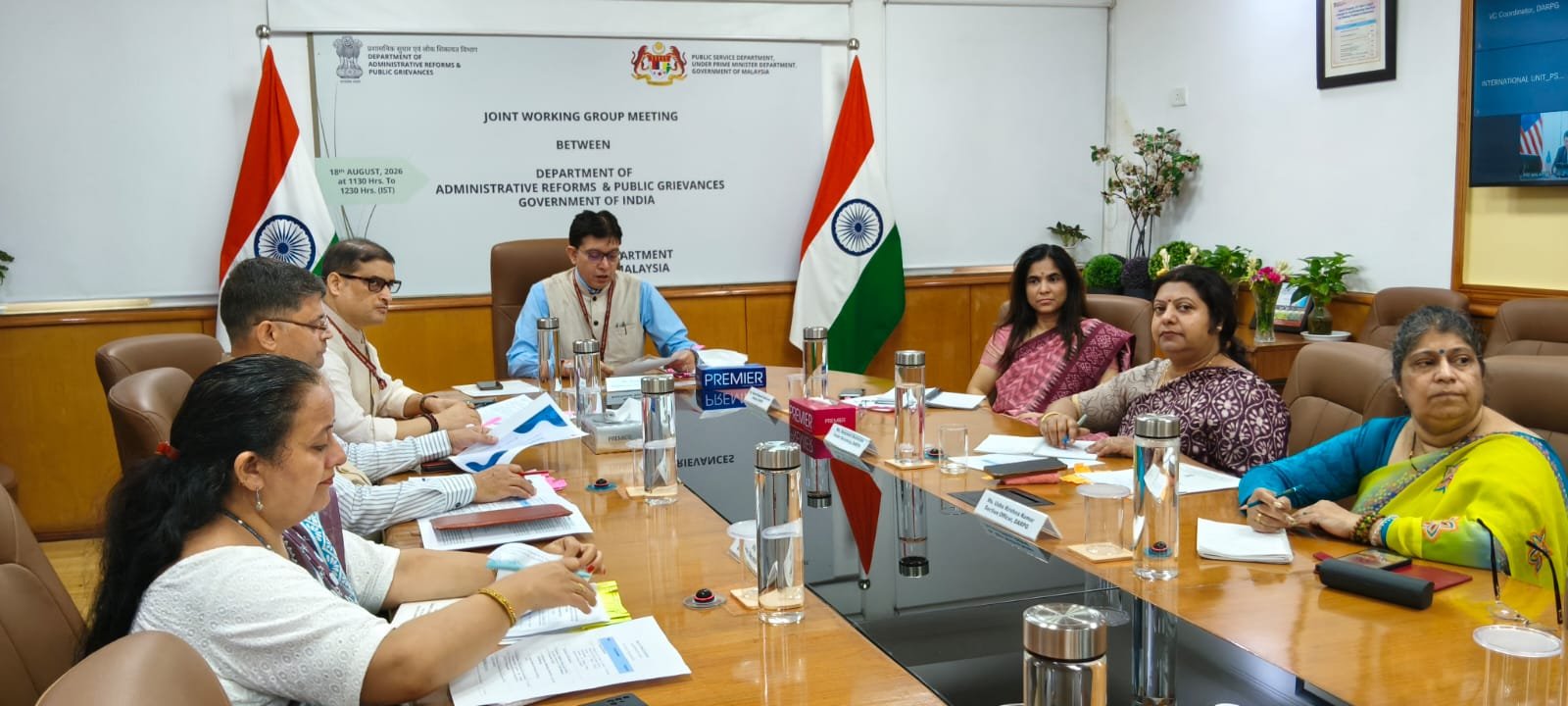
NEW DELHI — In a major step toward deepening administrative ties, the Department of Administrative Reforms and Public Grievances (DARPG) under the Ministry of Personnel, Public Grievances & Pensions hosted the 2nd India–Malaysia Joint Working Group (JWG) Meeting on Cooperation in the Field of Public Administration and Governance Reforms.
Co-chaired by Shri Puneet Yadav, Additional Secretary (DARPG), and Mr. Datuk Dr. Mohd Bakhari bin Ismail, Deputy Director General of Public Service (Development), Malaysia, the bilateral summit focused on institutional capacity building, public sector modernization, and digital governance innovations.
Key Highlights & Strategic Roadmap
-
Institutional Framework: Formalized and adopted the minutes of the inaugural JWG meeting, establishing designated Points of Contact to streamline bilateral project execution.
-
Strategic Roadmap (2027–2029): The Malaysian delegation presented a three-year implementation roadmap to structure ongoing collaboration under the existing governance Memorandum of Understanding (MoU).
-
Expanded Capacity Building: Evaluated ongoing civil service training under the Indian Technical and Economic Cooperation (ITEC) Programme, with plans to introduce specialized executive modules for senior Malaysian officials via the National Centre for Good Governance (NCGG).
-
Public Sector Transformation: Focused on Malaysia’s strategy integrating People, Process, and Technology, alongside shared interests in AI, cloud infrastructure, cybersecurity, and blockchain.
Showcase of Digital Governance Platforms
During the proceedings, DARPG highlighted India’s flagship administrative and citizen-centric technology platforms, emphasizing the scale and accessibility of its public grievance architecture:
-
CPGRAMS Integration: Showcased the Centralized Public Grievance Redressal and Monitoring System as the world’s largest 24×7 digital interface for citizen grievance handling.
-
AI-Driven Accessibility: Demonstrated Samadhan Didi, the AI-enabled multilingual voice chatbot introduced to enhance CPGRAMS accessibility, streamline citizen interactions, and automate real-time response mechanisms.
