



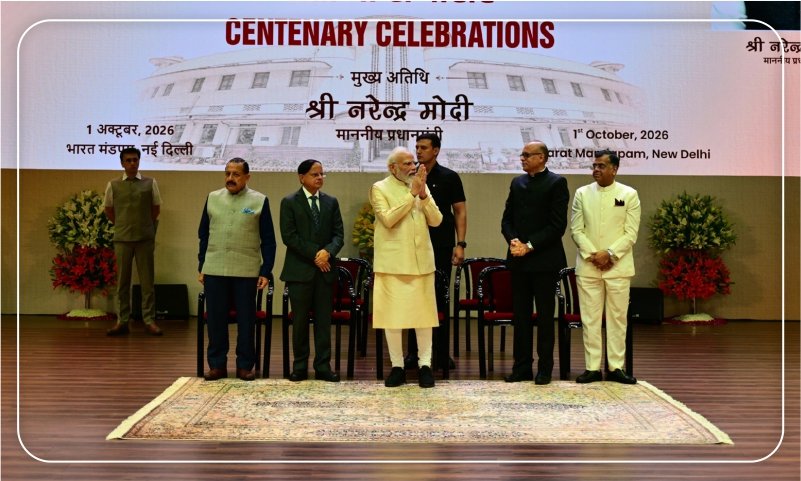
NEW DELHI — Prime Minister Narendra Modi participated in the Centenary Celebrations of the Union Public Service Commission (UPSC) today, October 1, 2026, at Bharat Mandapam.
Marking 100 years since the commission’s inception in 1926, the Prime Minister commemorated the milestone by releasing a commemorative postage stamp, a special coin, and a compilation of 100 significant case laws.
Key Highlights & Centenary Milestones
-
Institutional Evolution: Recalled the transition of the body from its British Raj origins to its modern role, paying tribute to Sardar Vallabhbhai Patel for establishing the civil services as independent India’s “steel frame.”
-
Demographic Shift in Public Services: Highlighted the expanded talent pool, noting a 45-fold increase in exam candidates since 1976 and a rise in female representation among selected candidates from 3% in 1952 to over 30% today.
-
Core Institutional Values: Stressed that as the UPSC enters its second century, its foundational pillars—independence, impartiality, merit, confidentiality, and fair processes—must remain eternally uncompromised.
Reforms in Selection & Governance Philosophy
The Prime Minister outlined an administrative blueprint to align civil services recruitment with the goal of achieving a Viksit Bharat by 2047:
-
Recruitment Philosophy Shift: Urged recruitment agencies to evaluate underlying motivation alongside academic knowledge, selecting individuals driven by Public Service rather than Public Office.
-
The ‘Nagrik Devo Bhava’ Mandate: Declared the elimination of legacy administrative mindsets, replacing them with a Pro-People, Pro-Active, Good Governance ethos that treats every citizen as divine.
-
Addressing Emerging Global Challenges: Mandated that selection criteria evolve to test foresight and complex problem-solving abilities capable of navigating AI, information warfare, deepfakes, algorithmic bias, and climate justice.
-
Time Certainty & Cycle Reduction: Called on examination bodies to shorten recruitment cycles without lowering standards, framing the reduction of exam duration as an equity reform that eases financial burdens on candidates.
-
Digital Capacity Building: Advised leveraging digital platforms such as i-GOT under Mission Karmayogi to institutionalize continuous capacity building across national and state selection commissions.
