



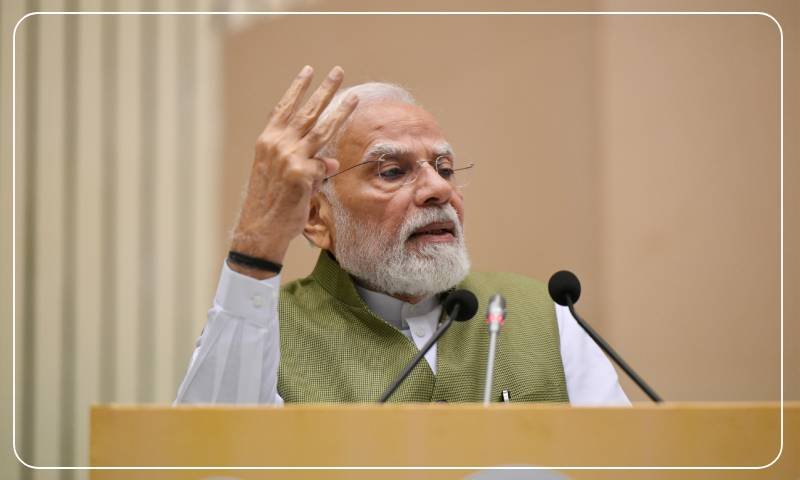
NEW DELHI — Prime Minister Narendra Modi addressed the International Conference on “The Future of Environment and Climate Dynamics,” organized by the National Green Tribunal (NGT) in New Delhi.
Speaking before Chief Justice of India Justice Surya Kant, Union Environment Minister Bhupender Yadav, Attorney General R. Venkataramani, and NGT Chairperson Justice Prakash Shrivastava, the Prime Minister highlighted India’s dual approach of leveraging ancient cultural conservation ethics while delivering technological and policy solutions to global climate challenges.
Core Takeaways from the Address
-
Decarbonization Leadership: India stands as the only G20 nation to have fulfilled its COP-21 Paris Agreement climate commitments ahead of the stipulated deadline.
-
Per Capita Emission Realities: India’s per capita carbon emissions remain less than half of the global average, whereas developed nations produce over six times more per capita emissions than India.
-
Solar Energy Expansion: India’s solar capacity expanded eighty-fold over the past 12 years—scaling from approximately 2 GW to over 160 GW.
-
Rooftop & Rural Solar Operations: Over 50 lakh households have installed rooftop solar panels under the PM Surya Ghar Muft Bijli Yojana (supported by subsidies up to ₹80,000 per household), while 30 lakh farmers have received solar pumps via the PM-KUSUM scheme.
-
Emissions Offsetting: Solar installations nationwide have successfully prevented nearly 20 crore (200 million) tonnes of carbon emissions to date.
Clean Mobility, Transit & Infrastructure Benchmarks
The Prime Minister outlined significant milestones in clean transportation and public transit infrastructure over the past 12 years:
-
Hydrogen & Rail Electrification: India operationalized its first hydrogen-powered train—marking the longest hydrogen train route globally. Indian Railways has achieved nearly 100% electrification, complemented by the recent commissioning of a 3,000 km Dedicated Freight Corridor.
-
Electric Vehicle (EV) Surge: EV adoption grew 950-fold, rising from under 3,000 units sold annually prior to 2014 to nearly 25 lakh (2.5 million) vehicles sold last year.
-
Urban Transit Network: Expanded operational metro rail systems from under 250 km across 5 cities in 2014 to over 1,000 km across more than 20 cities today.
-
Inland Waterways: Developed approximately 5,000 km of operational inland waterways, transferring heavy freight from road to eco-friendly river transport.
Ecological Conservation, Agriculture & Circular Economy
-
Forest Cover Growth: India recorded a more than 22% increase in its Very Dense Forest (VDF) cover over the last 12 years, boosted further by mass plantation drives like ‘Ek Ped Maa Ke Naam’.
-
Water Security Infrastructure: Completed over 70,000 Amrit Sarovars and built 1.5 crore water harvesting structures under the ‘Catch the Rain’ campaign.
-
Sustainable Agriculture: Established 24,000 natural farming clusters covering 12.5 lakh hectares under the National Mission on Natural Farming, alongside developing 3,000 climate-resilient crop varieties.
-
Waste-to-Wealth Initiatives: Implemented a nationwide ban on single-use plastics and accelerated circular economy models through the GOBARdhan scheme to convert agricultural and organic waste into bio-energy resources.
