



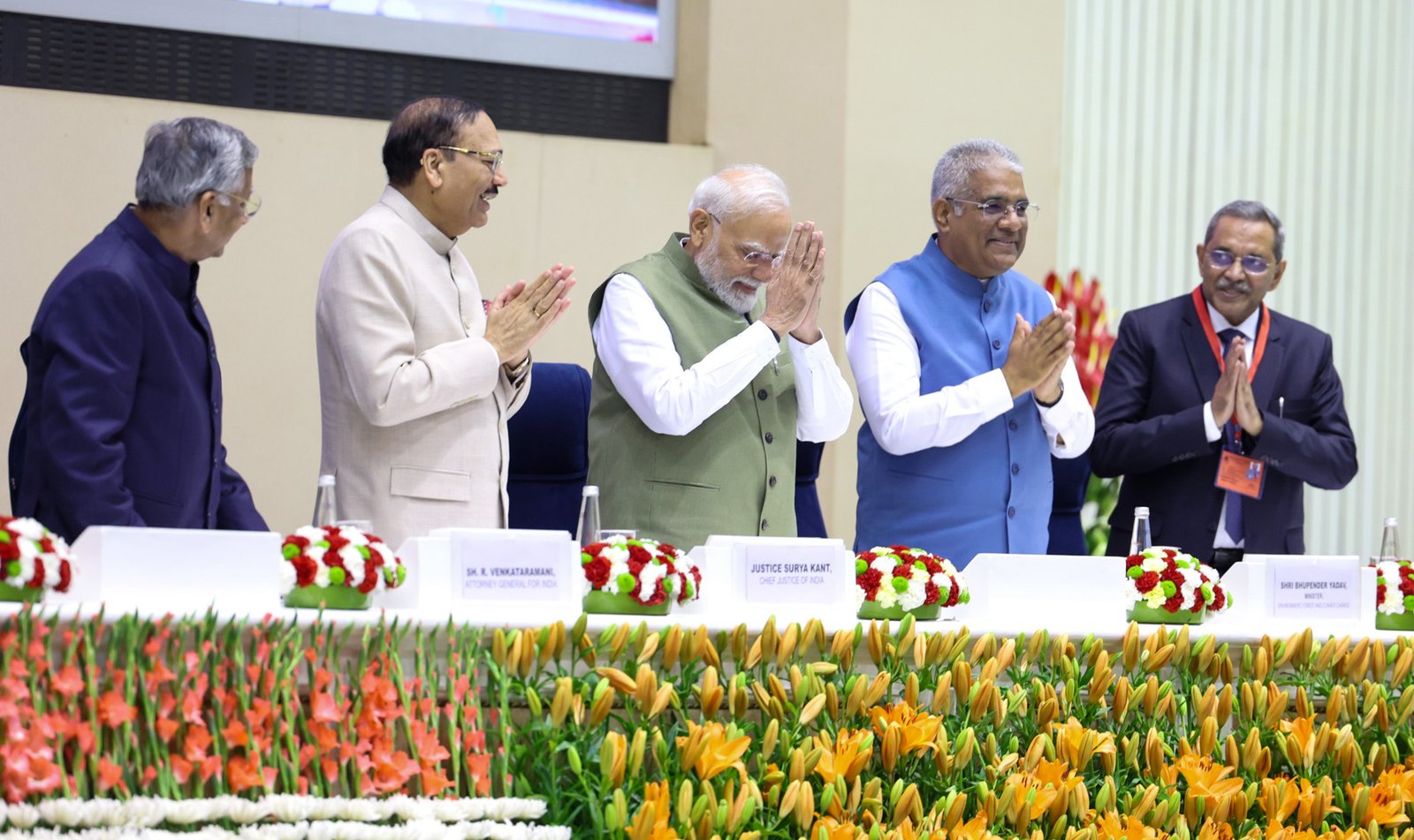
NEW DELHI — Prime Minister Narendra Modi inaugurated the International Conference on “The Future of Environment and Climate Dynamics” at Vigyan Bhawan, asserting that India has demonstrated how rapid economic development can coexist with environmental sustainability.
Organized by the National Green Tribunal (NGT), the event convened senior judicial and policy leaders, including Chief Justice of India Justice Surya Kant, Union Environment Minister Bhupender Yadav, Attorney General R. Venkataramani, and NGT Chairperson Justice Prakash Shrivastava.
Key Takeaways from the Inaugural Address
-
Global Commitments: India remains the sole G-20 nation to have met its COP-21 Paris Agreement commitments ahead of schedule.
-
Per Capita Emission Realities: India’s per capita carbon emissions stand at less than half of the global average, while developed nations produce up to six times more carbon per capita.
-
Solar Energy Growth: Solar power capacity expanded eighty-fold over the last 12 years—scaling from 2 gigawatts (GW) to over 160 GW.
-
Rooftop & Agricultural Solar: Over 50 lakh homes have been solarized under the PM Surya Ghar Muft Bijli Yojana (supported by subsidies up to ₹80,000 per household), alongside 30 lakh farmers benefiting from solar pumps under the PM-KUSUM scheme.
-
Emissions Reduction: The completion of the ‘One Nation-One Grid’ project and broader solar deployment have prevented 200 million (20 crore) tonnes of carbon emissions.
Infrastructure, Clean Mobility & Logistics Milestones
The Prime Minister outlined major advancements across green transit, clean power generation, and public transport infrastructure over the past 12 years:
-
Hydrogen & Rail Electrification: India launched its first Hydrogen Train—the world’s longest hydrogen-powered train service. Near-100% railway electrification is now supplemented by a 3,000 km Dedicated Freight Corridor utilizing double-stack container trains.
-
Electric Vehicle (EV) Adoption: Annual EV sales expanded 950-fold, rising from under 3,000 units prior to 2014 to approximately 25 lakh (2.5 million) vehicles last year.
-
Urban Transit & Waterways: Expanded metro networks from 250 km across 5 cities in 2014 to over 1,000 km across more than 20 cities today. Inland waterway transport has reached 5,000 operational kilometers.
-
Clean Energy Diversification: Wind energy capacity tripled over 12 years, accompanied by nuclear energy sector reforms opening participation to private players and progress in coal gasification technologies.
Ecological Stewardship, Agriculture & Circular Economy
-
Forest Cover Increase: Very Dense Forest (VDF) cover increased by over 22% over the last 12 years, supported by mass drives such as the ‘Ek Ped Maa Ke Naam’ campaign.
-
Water Management: Constructed over 70,000 Amrit Sarovars and 1.5 crore rainwater harvesting structures under the ‘Catch the Rain’ campaign, while modernizing irrigation for 2 crore farmers via the Pradhan Mantri Krishi Sinchayee Yojana.
-
Sustainable Agriculture: Established 24,000 natural farming clusters covering 12.5 lakh hectares under the National Mission on Natural Farming, accompanied by 3,000 climate-resilient crop varieties and increased production of water-efficient Shree Anna (millets).
-
Waste Management: Enforced a ban on single-use plastics and accelerated circular economy models through the GOBARdhan scheme to convert rural organic waste into bio-energy resources.
