



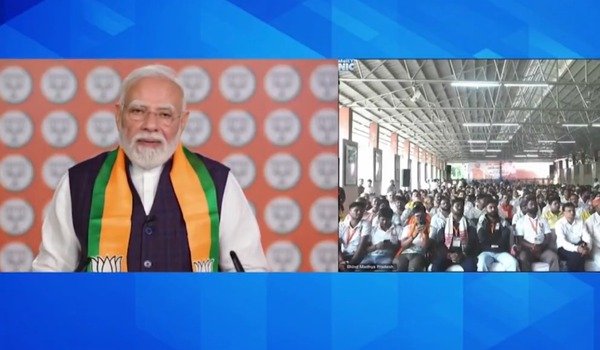
NEW DELHI — Prime Minister Narendra Modi interacted virtually with Seva Yatris undertaking a journey from Vadnagar to Varanasi, emphasizing that public service (Seva) must remain the core purpose of life and the guiding principle of governance.
Reiterating the foundational ethos of “Seva Paramo Dharma” (Service is the highest duty), the Prime Minister highlighted that even upon reaching the highest political offices, the commitment to serve the nation and its people should remain paramount.
Service as the Engine of Policy and Governance
During the interaction, Prime Minister Modi underscored that integrating the spirit of service into national policy leads to transformative economic and social outcomes:
-
Last-Mile Delivery: Key social welfare initiatives such as PM-KISAN and the PM Surya Ghar Yojana succeed because they prioritize reaching the most vulnerable citizens.
-
Poverty Alleviation: Direct, service-driven policy interventions have successfully lifted 25 crore citizens out of multidimensional poverty while providing permanent housing to over 4 crore poor families.
-
Nation-Building Beyond Politics: Emphasizing that elections and political systems are routine aspects of democracy, the Prime Minister noted that the ultimate objective remains building a developed nation (Viksit Bharat).
Empowering Youth as Architects of ‘Viksit Bharat 2047’
Addressing the young participants on the yatra, Prime Minister Modi called on youth across the country to active roles in driving India’s progress toward the goal of becoming a developed nation by 2047.
“Today’s young generation is both the primary architect of a developed India and its ultimate beneficiary.”
Ground-Level Impact along the Vadnagar-Varanasi Route
The Seva Yatris shared real-time updates and field experiences from their journey spanning from the Prime Minister’s birthplace in Vadnagar to his parliamentary constituency of Varanasi:
-
Environmental Initiatives: Participants conducted extensive tree plantation drives along the route.
-
Community Cleanliness: Organizing localized Swachhata (cleanliness) campaigns across towns and villages.
-
Grassroots Feedback: Engaging directly with local communities to gather first-hand feedback on the real-world impact of government welfare programs.
