



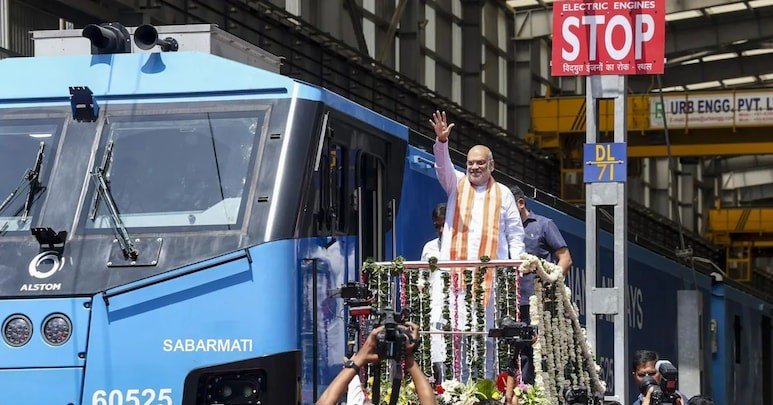
AHMEDABAD — Union Home and Cooperation Minister Amit Shah, alongside Gujarat Chief Minister Bhupendra Patel, flagged off India’s first Liquefied Natural Gas (LNG)-powered train from Sabarmati, marking a major technological transition toward alternative energy in Indian Railways operations.
The event formed part of a comprehensive ₹1,542 crore railway infrastructure package inaugurated in Ahmedabad, encompassing high-capacity freight sheds, indigenous safety systems, and line capacity expansions.
Key Operational Metrics & Dual-Fuel Technology
-
Dual-Fuel Engine Conversion:
-
Configuration: Converted two 1,400 HP Driving Power Cars (DPCs) at the Sabarmati Integrated Coaching Depot to run on a diesel-plus-LNG dual-fuel system.
-
Substitution Rate: Replaces up to 40% of conventional diesel consumption with LNG without compromising engine power or operational capabilities.
-
Fuel Capacity & Range: Each DPC is fitted with a 2,200-litre LNG tank (holding ~850–900 kg usable LNG), providing a single-fill operational range of 1,600 km.
-
Field Testing: Successfully completed over 2,000 km of field trials prior to commercial launch.
-
-
Economic & Environmental Impact:
-
Cost Efficiency: Expected to yield annual fuel savings of ₹11.9 lakh per DPC (~₹23.9 lakh per 8-coach rake).
-
Emissions Reduction: Demonstrates measurable decreases in Carbon Dioxide ($CO_2$), Nitrogen Oxides ($NO_x$), and particulate matter.
-
Broader Railway Infrastructure Package (₹1,542 Crore)
-
WAG-12 Maintenance Shed: Inaugurated a ₹700-crore maintenance facility at Sabarmati and flagged off a WAG-12 high-horsepower electric locomotive.
-
Kavach Safety Integration: Commissioned the indigenous Kavach automatic train protection system across the Ahmedabad–Palanpur and Ahmedabad–Samakhiyali routes.
-
Capacity Enhancement: Launched automatic signaling on two key sections and initiated track-doubling operations on the Sabarmati–Sarkhej line.
