



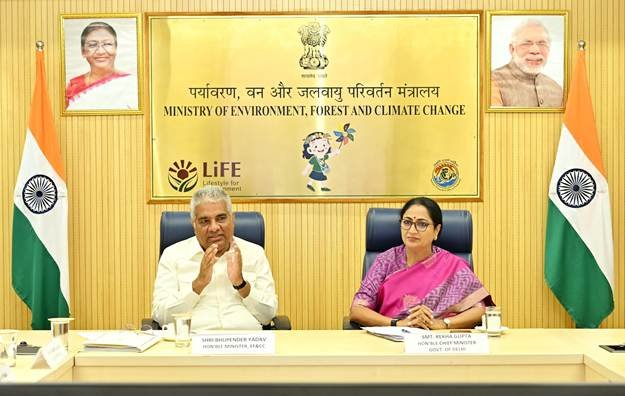
NEW DELHI — Union Minister for Environment, Forest and Climate Change Bhupender Yadav chaired a high-level review meeting with Delhi Chief Minister Rekha Gupta to finalize a time-bound, outcome-oriented strategy for combating air pollution in the National Capital Region (NCR) ahead of the winter season.
The strategic session, attended by Delhi Environment Minister Sardar Manjinder Singh Sirsa, Public Works Department (PWD) Minister Pravesh Sahib Singh, and senior officials from the Commission for Air Quality Management (CAQM) and Central Pollution Control Board (CPCB), established targeted action plans across 37 designated pollution hotspots, with a deadline of October 10 for full implementation and community engagement (Jan Bhagidari).
Key Action Points & Enforcement Mandates
-
Hotspot Management & Public Engagement: Public representatives and administrative teams will conduct field reviews at identified hotspots. Action plans for NCR areas will be finalized by October 10.
-
Strict Vehicular Controls: A city-wide “No PUCC, No Fuel” mandate will be enforced across all 500 ANPR-enabled fuel stations. Effective November 1, 2026, entry for non-BS-VI vehicles registered outside Delhi (excluding EVs and CNG vehicles) will be restricted.
-
Public Transit Prioritization: To curb private vehicle use, a registration drive for the Delhi Metro Sarthi App will run from October 1 to 10. Delhi’s active bus fleet has reached 6,840 units, including 5,088 electric buses.
-
Dust & Waste Mitigation: End-to-end footpath paving and road redevelopment across 1,193 km have been completed, with remaining stretches targeted for November 15. A total ban on dust-generating demolition and civil construction will run from November 1 to January 31, expanding to a complete construction ban from December 10 to January 20. Registrations on the Malba App will be mandatory for building plan approvals.
-
Winter Emergency Protocols: In-advance winter measures include doubling parking fees, staggering office hours, introducing 50% work-from-home guidelines, deploying 334 industrial enforcement teams, and establishing an AI-enabled Command and Control Centre while expanding air monitoring stations from 47 to 60.
