



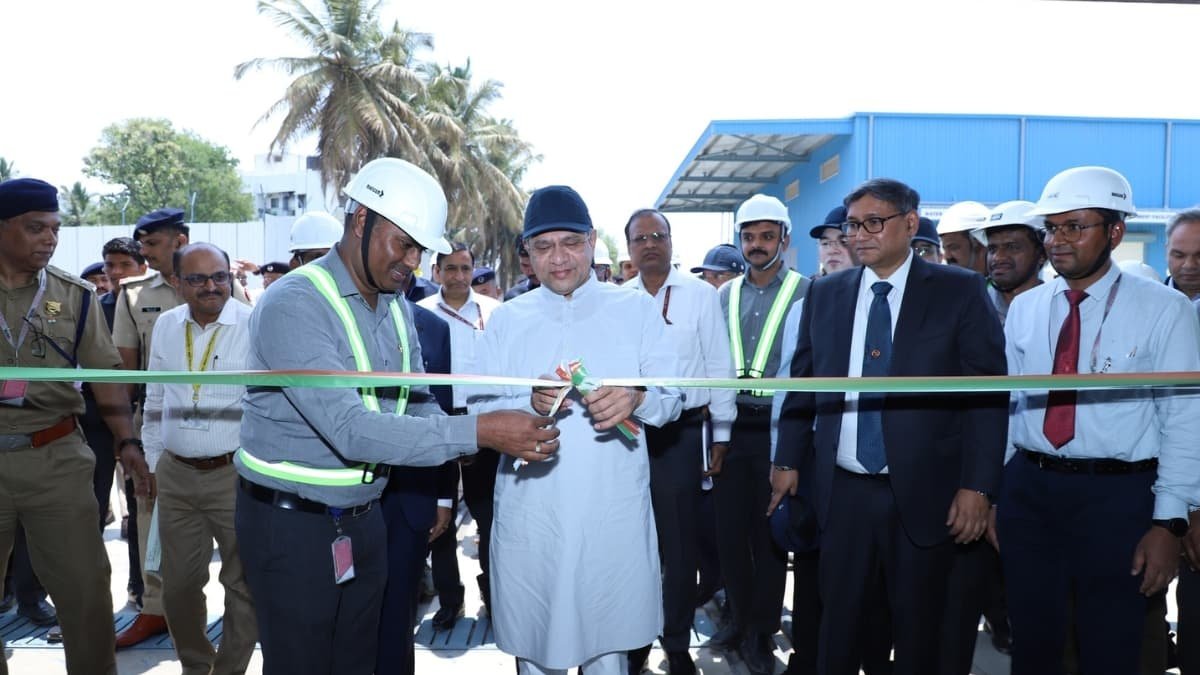
BENGALURU — Union Minister Ashwini Vaishnaw has inaugurated the Aditya High-Speed Rail Complex, a dedicated hub for manufacturing India’s first indigenous bullet train platform. Operated by BEML Limited, the facility marks a major milestone in India’s journey toward becoming a global leader in high-speed rail technology.
The inauguration was attended by Satish Kumar (Chairman, Railway Board) and Shantanu Roy (CMD, BEML), signaling a unified push between the government and public sector manufacturing to redefine national connectivity.
Manufacturing the B-28 Trainsets
The Aditya complex is specifically engineered to produce the B-28 trainsets, India’s homegrown answer to high-speed transit. This facility is the backbone of the country’s “Make in India” ambitions for the bullet train project, moving away from a total reliance on foreign technology.
Cutting-Edge Infrastructure
To meet the rigorous precision standards required for high-speed travel, the complex is equipped with:
-
Robotic Laser Welding: Ensuring structural integrity and aerodynamic precision.
-
Universal Hydraulic Jigs: For heavy-duty assembly and alignment of train chassis.
-
Integrated Outfitting Systems: Consolidating mechanical and electrical assembly under one roof to boost efficiency.
Strategic Impact
The Railway Minister emphasized that these high-speed platforms will do more than just save time; they are designed to:
-
Accelerate Economic Corridors: Linking major urban hubs to foster trade and industrial growth.
-
Achieve Self-Reliance: Reducing the cost of future high-speed projects by indigenizing production.
-
Future-Proof Connectivity: Providing a scalable platform for future rail expansions across India.
“High-speed rail will redefine connectivity by bringing cities closer and accelerating economic growth.” — Ashwini Vaishnaw, Union Minister
With the launch of the Aditya complex, Bengaluru further solidifies its reputation as the “Silicon Valley” of not just software, but advanced industrial engineering. The facility is expected to immediately begin production cycles for the first generation of indigenous B-28 trainsets.
