



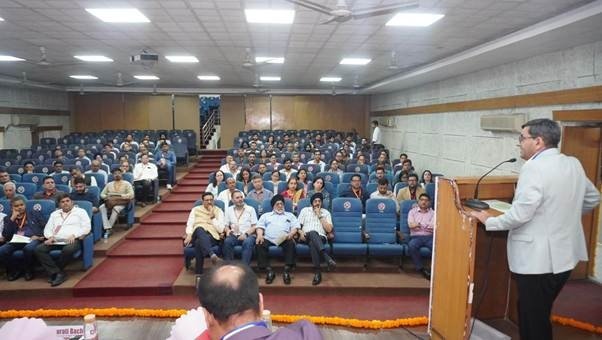
JAMMU – The Indian Pharmacopoeia Commission (IPC), in collaboration with CSIR, successfully organized a high-level Scientific Conclave and Interactive Session on the Indian Pharmacopoeia (IP) 2026. Held at the CSIR-Indian Institute of Integrative Medicine (CSIR-IIIM) on April 17, the event served as a critical platform for advancing drug standards in India.
The conclave aimed to align regulators, academia, and industry leaders to ensure the highest levels of quality, safety, and efficacy for medicines distributed across the nation.
Strengthening Global Competitiveness
The inaugural session featured senior experts who underscored the importance of evolving drug standards to meet global scientific and regulatory benchmarks. The Indian Pharmacopoeia was reaffirmed as the primary tool for maintaining uniform quality in the pharmaceutical sector.
Key Technical Highlights of IP 2026
The technical sessions provided deep dives into the updates specifically designed for the 2026 edition:
-
Monograph Revision: Focused on the development and revision of monographs to reflect modern medicine.
-
Impurity Standards: Strengthening protocols for identifying and managing impurities in drug formulations.
-
Phytopharmaceuticals: Setting rigorous standardization for plant-based medicinal products.
-
Advanced Analytics: Transitioning toward modern analytical approaches to improve testing precision.
-
Biological Standards: Enhancing microbiological and blood-related quality standards.
Stakeholder Collaboration
An interactive session allowed industry representatives to discuss their preparedness for the implementation of IP 2026. Participants emphasized that the success of these updated standards relies on a “triple-helix” collaboration between regulatory bodies, the pharmaceutical industry, and scientific institutions.
Commitment to Public Health
The conclave concluded with a reaffirmation from the IPC to continuously upgrade pharmacopoeial standards. By integrating scientific advancements with stakeholder feedback, the commission aims to build a more robust public health safeguard system, ensuring that Indian medicines remain trusted both domestically and internationally.
