



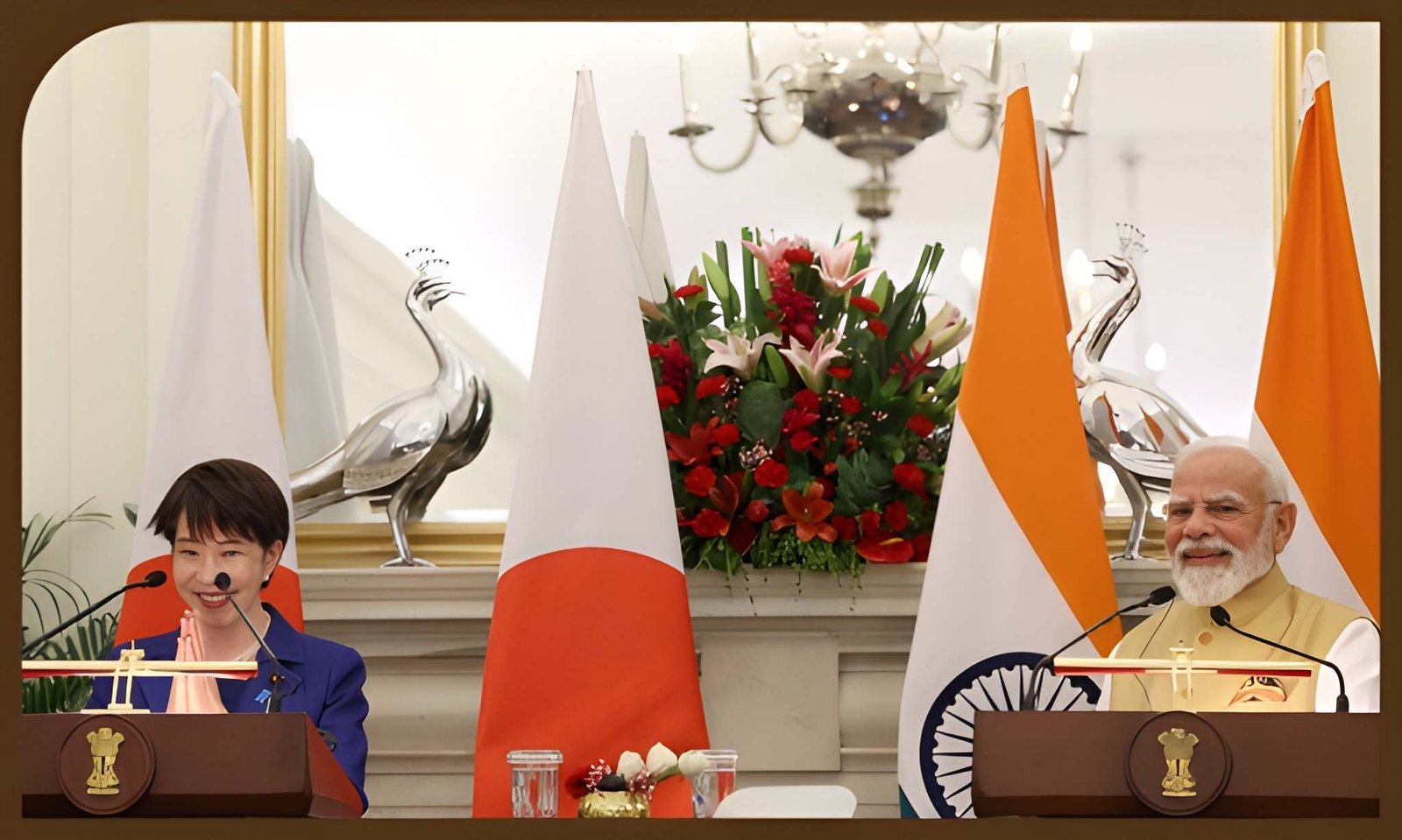
NEW DELHI — In a major geopolitical development in the Indo-Pacific region, Prime Minister Narendra Modi and Japanese Prime Minister Sanae Takaichi have concluded the India-Japan Annual Summit by signing a series of deep-tech, defense, and economic security agreements. The bilateral meet marked Prime Minister Takaichi’s first state visit to New Delhi since becoming Japan’s first female head of government.
The high-level talks culminated in a joint commitment to transform mutual diplomatic trust into hard technological integration, focused heavily on neutralizing economic vulnerabilities and securing maritime boundaries.
Core Summit Deliverables & Bilateral Outcomes
-
Naval Hardware Co-Development: Marking a major milestone in bilateral defense ties, India and Japan signed an agreement to jointly develop a Naval Radio Antenna. This project establishes their first military-technological co-development framework, moving the alliance into shared defense engineering.
-
Precision-Software AI Union: The leaders issued a formal Joint Statement on Artificial Intelligence, flanked by multiple institutional pacts between Indian technology centers and Japanese enterprises. The initiative is structured to combine Japan’s precision hardware technology with India’s software scale.
-
Supply Chain Protections: A newly ratified Joint Roadmap for Economic Security will see both nations coordinate policies to protect and diversify supply chains across critical sub-sectors, specifically Semiconductors, Quantum Computing, and Advanced Materials.
-
Macro Investment Goals: Backed by new financial regulatory agreements to ease capital flows, the summit re-affirmed a bilateral target to attract 10 trillion yen in Japanese investment to India over the next decade while actively working to double the number of Japanese firms operating in the Indian market.
-
Rural Energy Deployment: Under the India-Japan Bio-gas Initiative, the two countries will collaborate to install 1,000 bio-gas and organic fertilizer plants across rural India, integrating external capital into India’s Gobar-Dhan sustainability scheme.
Next-Gen Logistics Framework
To expand on their established corporate alliances in passenger vehicle manufacturing, the two nations signed the India-Japan Next Generation Mobility Partnership Framework. This new protocol scales joint commercial efforts into three strategic heavy-industry sectors: shipbuilding, aviation, and advanced logistics.
The cross-border agreements lay the operational groundwork ahead of the 75th anniversary of India-Japan diplomatic relations, which both nations will officially celebrate next year.
