



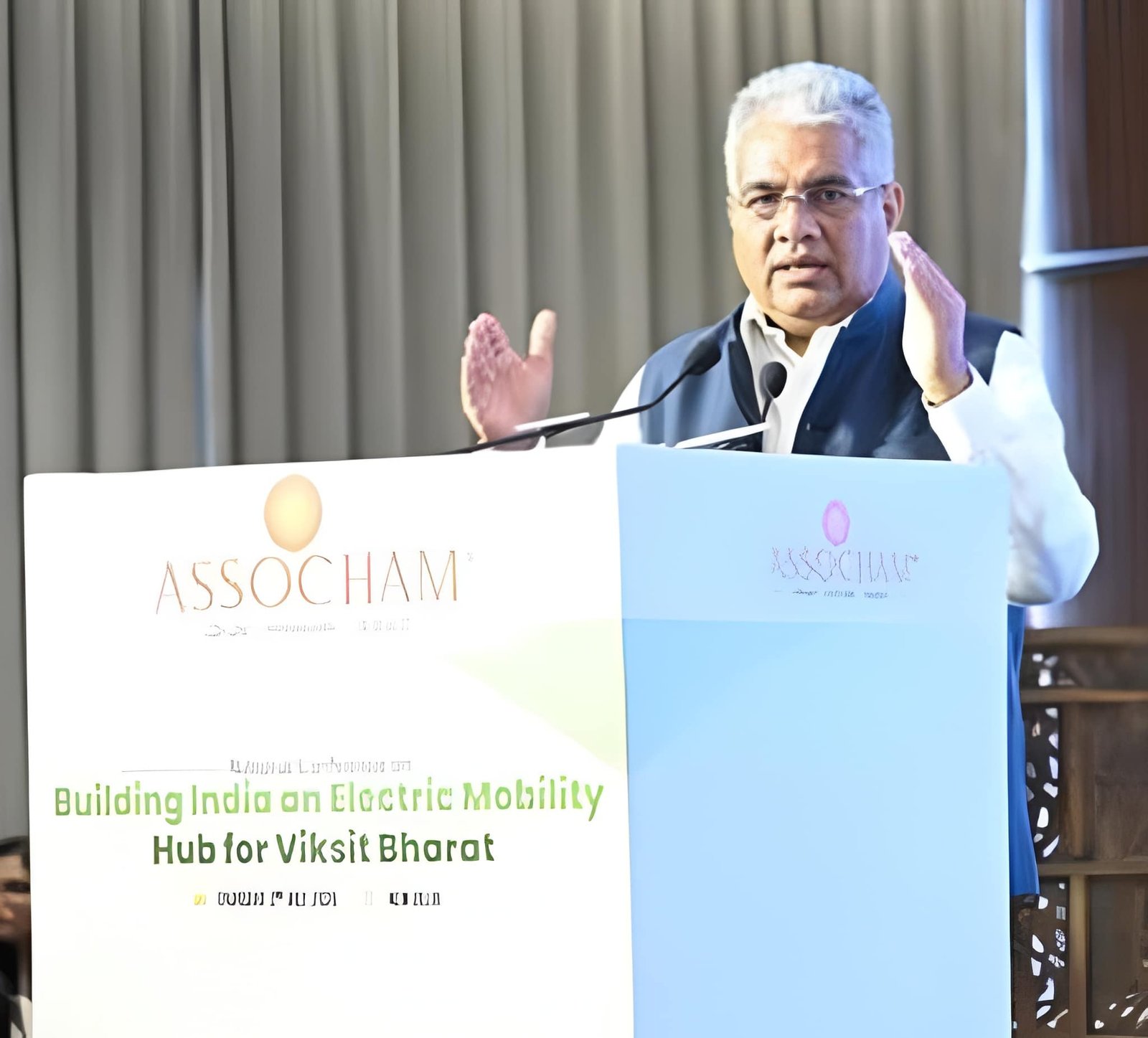
NEW DELHI — Highlighting the critical intersection of industrial growth and ecological preservation, Union Minister for Environment, Forest and Climate Change, Shri Bhupender Yadav, presided over ASSOCHAM’s National Conference on ‘Electric Mobility: Building India an Electric Mobility Hub for Viksit Bharat’ as the Chief Guest in New Delhi today.
The high-level convention convened major automotive manufacturers, tech providers, senior policymakers, and industry stakeholders to chart a cohesive roadmap for accelerating India’s electric vehicle (EV) deployment and positioning the nation as an international clean mobility hub ahead of the Viksit Bharat 2047 timeline.
The Four Pillars of E-Mobility Transition
In his inaugural address, Union Minister Bhupender Yadav emphasized that the country’s shift toward vehicle electrification is a complete structural overhaul of the industrial landscape, rather than a mere technological substitution. He asserted that the long-term sustainability of the sector rests heavily on four foundational pillars:
-
Green Growth & Job Creation: Building a domestic industrial ecosystem that scales manufacturing while generating sustainable, green-collar employment.
-
Resilient Infrastructure: Rapidly deploying public and private charging infrastructure networks backed by robust power grids.
-
Transparent Governance: Utilizing digitized systems to accelerate compliance and project clearances.
-
Circular Economy: Mitigating battery waste through resource efficiency, life-cycle tracking, and advanced recycling frameworks.
Regulatory Overhauls & Ease of Doing Business
The Minister detailed a series of legislative and administrative reforms introduced by the Environment Ministry to unlock capital and accelerate manufacturing setups across the EV corridor:
-
Digital Approvals: Leveraging the PARIVESH portal to digitize, simplify, and expedite environmental clearances for industrial projects.
-
Rationalized Compliance: Lowering administrative barriers and enhancing the ease of doing business for EV and component manufacturers without compromising on statutory environmental safeguards.
-
Critical Mineral Security: Establishing secure supply chains for critical battery minerals while transitioning away from the linear “take-make-dispose” industrial model toward aggressive end-of-life battery recycling.
Industry Stewardship
The national conference witnessed active participation from apex industrial bodies and business leaders who collectively stressed the need for policy continuity, localized advanced manufacturing, and strategic financing frameworks. Notable industry dignitaries in attendance included:
-
Shri Nirmal K. Minda, President, ASSOCHAM and Chairman, UNO Minda.
-
Shri Nishant Arya, Chairman, ASSOCHAM National Council on Green Mobility and Vice CMD, JBM Group.
-
Shri Saurabh Sanyal, Secretary General, ASSOCHAM.
“Ecology and economy must progress together,” Minister Yadav concluded. “Through collaborative action, India can emerge as a global leader in sustainable manufacturing, green mobility, and climate-conscious development.”
