



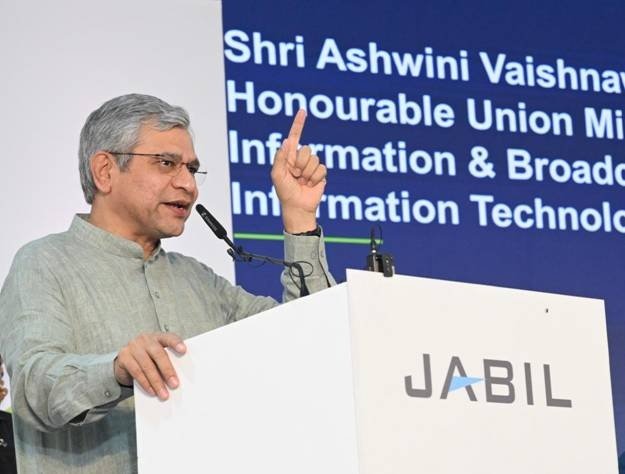
PUNE — Union Minister for Electronics and Information Technology Shri Ashwini Vaishnaw, alongside Maharashtra Chief Minister Shri Devendra Fadnavis, inaugurated a state-of-the-art advanced manufacturing facility for electronics manufacturing services giant Jabil Inc. at Ranjangaon, Pune.
The high-tech facility will serve as an export-centric data center component hub, directly supporting the Make in India vision by localizing the production of high-end hardware that powers global artificial intelligence infrastructure.
Key Operational Capabilities of the Jabil Pune Plant
The newly unveiled facility specializes in complex, high-precision electronic equipment designed to meet both domestic technology demands and highly competitive international export standards:
-
AI Systems Infrastructure: Manufacturing critical components and specialized hardware architectures for AI-enabled data centers.
-
Telecommunications & Networks: Building localized 5G technology units and advanced high-end networking gears.
-
Industrial & Consumer Electronics: Producing heavy industrial power system electronics alongside high-volume consumer tech lines.
Socio-Economic Impact and Localization Targets
The project is structured to deeply integrate regional businesses and the local workforce into the global tech supply chain:
Employment and MSME Integration: The high-tech plant is projected to scale up localized employment to 11,000 personnel. Concurrently, Jabil will execute a deep localization program designed to loop Indian Micro, Small, and Medium Enterprises (MSMEs) directly into high-precision engineering ecosystems.
Strategic Growth: India’s Electronics Export Evolution
Highlighting the rapid trajectory of the domestic electronics sector, Minister Vaishnaw shared data detailing how targeted central policies have transformed the industry’s footprint. The total value of India’s electronics manufacturing industry has scaled to an unprecedented ₹13 lakh crore.
Moving away from historical positions outside the top-ten brackets, electronics exports climbed rapidly over recent years from the 9th rank up through the 7th, 5th, and 4th positions. As of 2025, electronics officially established itself as the country’s third-largest export category.
The next horizon for the central and state governments is to collaborate with investors to push process quality and elevate the sector into the second-largest export bracket. To sustain this momentum, the central government has committed to extensive investments in precision technical talent, skill creation, and specialized supply chains for high-precision mechanical components—including exploring partnerships with advanced material and equipment innovators like Lyten to secure local raw feeds.
