



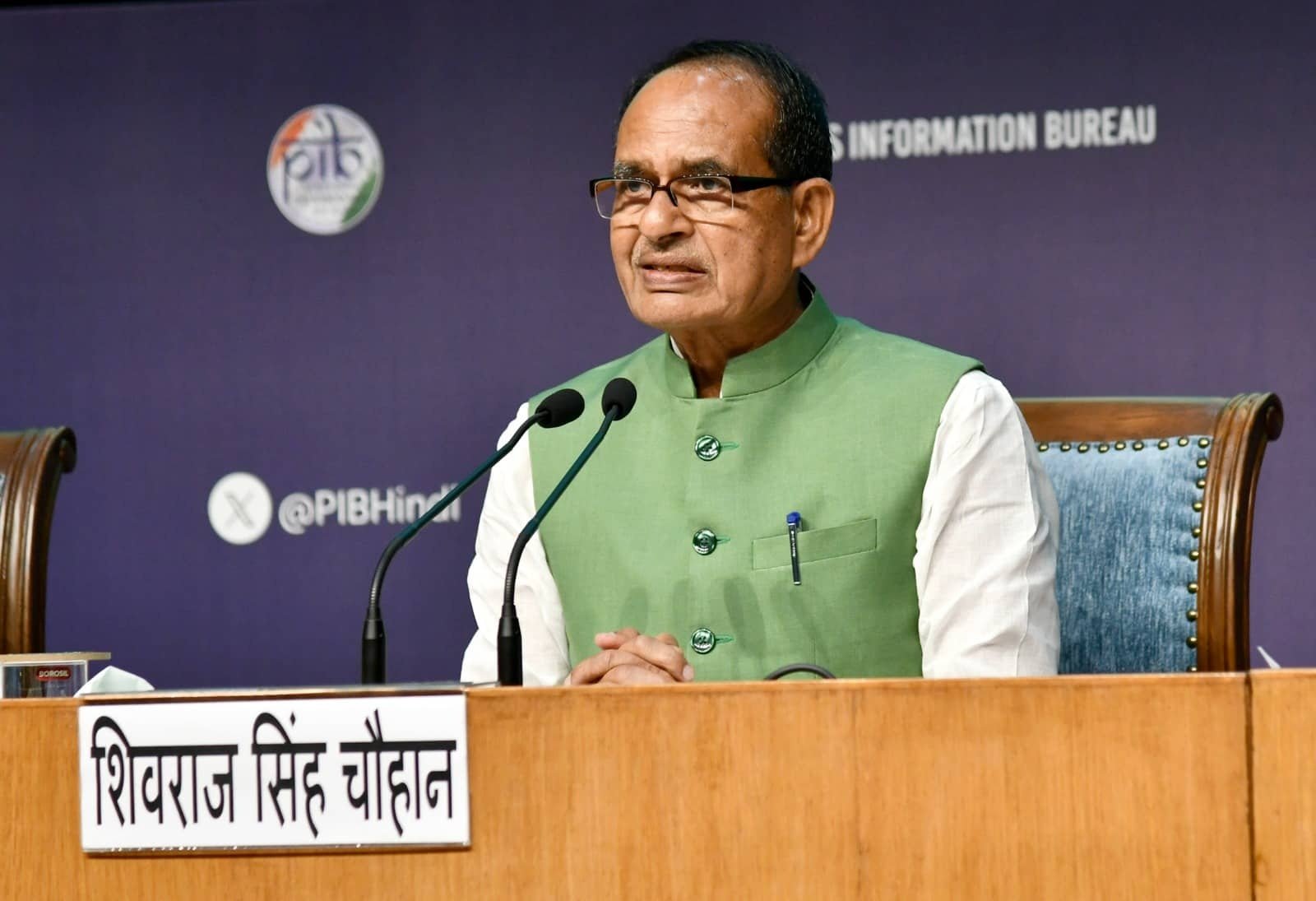
NEW DELHI: Highlighting a historic year for Indian agriculture, Union Minister for Agriculture and Farmers’ Welfare Shri Shivraj Singh Chouhan announced that the nation has achieved an unprecedented estimated foodgrain output of 376.563 million tonnes for the 2025-26 cycle. This landmark yield represents a massive surge of nearly 18.8 million tonnes compared to the previous year.
The declaration was made on May 28, 2026, during a press conference at the PUSA campus in New Delhi, coinciding with the launch of the two-day National Conference on Agriculture for the Kharif Campaign-2026. In a significant geopolitical milestone, the Minister revealed that India has officially surpassed China to become the world’s number one producer of rice, hitting a record benchmark of 154.024 million tonnes.
Unprecedented Production Across Key Crops
The Agriculture Minister credited the record-breaking harvest to the resilience of Indian farmers, active cooperation from state governments, robust policy support, and the deployment of newly developed high-yielding seed varieties.
The production breakdown highlights historic peaks across multiple staple and commercial crops:
-
Rice: Set a new global benchmark at 154.024 million tonnes, pushing India to the top spot globally.
-
Wheat: Reached an all-time high of 120.657 million tonnes.
-
Maize: Touched a record-breaking 55.092 million tonnes.
-
Total Oilseeds: Projected at a monumental 43.059 million tonnes, anchored by individual record yields in Rapeseed-Mustard (13.768 million tonnes) and Groundnut (13.074 million tonnes).
-
Pulses: Registered steady growth, with the Ministry identifying strong potential for further expansion.
‘Team Agriculture’ Framework and Regional Decentralization
Shri Chouhan emphasized that the two-day conference has effectively united ‘Team Agriculture’—a collaborative ecosystem comprising the Central Government, state authorities, scientists from the Indian Council of Agricultural Research (ICAR), and Farmer Producer Organisations (FPOs). Given that agriculture is constitutionally a state subject, the Union Minister reiterated that the Centre functions strictly as a partner and facilitator to state-led execution.
To account for India’s vast geographical and climatic variations, the ministry has reformed its consultation process:
-
Extended Timeline: The event has been expanded from a single-day meeting to a comprehensive two-day forum to allow for granular group discussions between central officials and individual states.
-
Regional Conferences: Moving past centralized dialogues, the government has already conducted three regional conferences in Jaipur, Lucknow, and Bhubaneswar, with two more slated for Southern India and the North-East.
-
Agro-Climatic Strategy: The Ministry is planning future regional conferences aligned specifically with the country’s eight distinct agro-climatic zones defined by ICAR, shifting away from standard zonal divisions to ensure schemes match local soil and weather profiles.
Shaping the Roadmap for Kharif 2026
With erratic weather patterns and rising temperatures presenting immediate vulnerabilities, climate change adaptation has been placed at the center of the Kharif 2026 roadmap. The conference is establishing dedicated protocols to safeguard small and marginal farmers while boosting long-term sustainability.
Key strategic focus areas under deliberation include:
-
Targeted Crop Missions: Accelerating dedicated national missions for oilseeds and pulses to achieve domestic self-reliance, alongside targeted reviews of the Cotton Mission and the Mission for Integrated Development of Horticulture.
-
Ecological Preservation: Promoting natural farming, utilizing Soil Health Cards, and restricting the rampant overuse of chemical inputs through balanced fertilizer awareness.
-
Financial and Credit Reforms: Correcting the uneven distribution of agricultural credit across states by expanding access to Kisan Credit Cards (KCC) and securing adequate investment capital for post-harvest management.
-
Digital Infrastructure: Streamlining grassroots deployment of the Agriculture Infrastructure Fund, the PM-AASHA scheme, digital agriculture tools, standardized Farmer IDs, and the nationwide ‘Khet Bachao Abhiyan’.
