



ÉVIAN-LES-BAINS (FRANCE) — Elevating India’s geopolitical footprint on the world stage, Prime Minister Narendra Modi addressed the high-profile Outreach Session of the 52nd G7 Summit in France, focusing squarely on “Forging New Partnerships and Rebuilding International Solidarity.”
Amid a tectonic shift in West Asian dynamics, Modi used the global platform to call for an immediate end to maritime transit disruptions, while orchestrating a series of critical bilateral engagements with key Asian, African, and European counterparts.
De-escalation Priorities and the Reopening of the Strait of Hormuz
The Prime Minister’s address to G7 leaders arrived at a critical juncture, immediately following a landmark peace framework brokered by US President Donald Trump that brought an end to the 107-day war between Washington and Tehran:
-
Restoring Global Supply Chains: Reflecting on the conflict—which triggered an acute international energy crisis when Iran blocked the Strait of Hormuz—PM Modi welcomed the de-escalation roadmap. He emphasized the collective global responsibility to ensure unhindered navigation through the waterway, which handles 20% of global oil shipments and is scheduled to fully reopen this Friday.
-
Humanitarian and Economic Concerns: Modi voiced serious concern regarding the profound economic and human toll of the conflict, revealing that several Indian nationals had tragically lost their lives during the West Asian hostilities.
-
The Strategic Formula: Backed by the Ministry of External Affairs (MEA), the Prime Minister asserted that “meaningful international solidarity” can only be realized when major powers commit strictly to state sovereignty, territorial integrity, and diplomacy over combat.
Anchoring the India-UAE and India-Korea Strategic Axes
On the sidelines of the scenic lakeside summit, Prime Minister Modi consolidated vital bilateral tracks with long-standing regional allies:
-
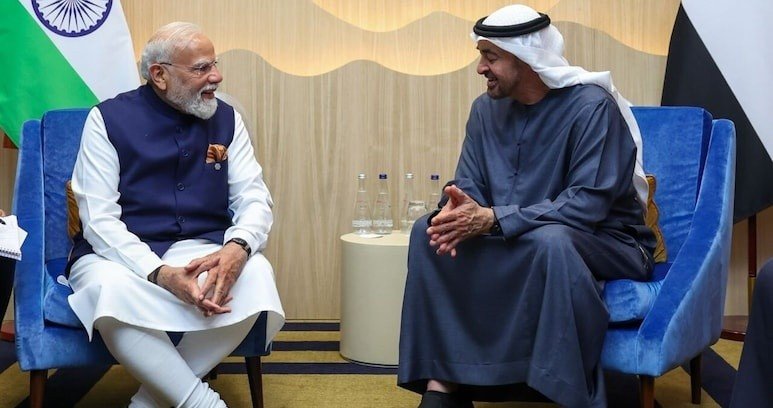
The India-UAE Core: Meeting for the third time in 2026, PM Modi and UAE President Sheikh Mohamed bin Zayed Al Nahyan finalized next-phase rollouts of their Comprehensive Strategic Partnership, specifically targeting technology integration, infrastructure investments, and defense manufacturing. Modi also extended an invitation to the UAE leader for the upcoming BRICS Summit in India.
-
The India-Korea Horizon: In a highly productive meeting with South Korean President Lee Jae-myung, the two leaders set a joint vision for the India-ROK Special Strategic Partnership (2026–2030). The agreement maps out extensive cross-border joint ventures across trade, cultural flows, and emerging deep-tech industrial sectors.
Expanding Bridges with the Global South and Japan
Operating during India’s 13th appearance as a G7 partner nation, the Prime Minister executed rapid bilateral handshakes to push forward economic and diplomatic alignment:
-
Japan: Modi met Japanese Prime Minister Sanae Takaichi, with both leaders agreeing to heavily prioritize supply-chain resilience and high-velocity investment flows into infrastructure.
-
Egypt & Kenya: Deliberated with Egyptian President Abdel Fattah El-Sisi on upgrading historic trade corridors, and held talks with Kenyan President William Ruto to amplify the unified economic voice and sustainable development goals of the Global South.
