



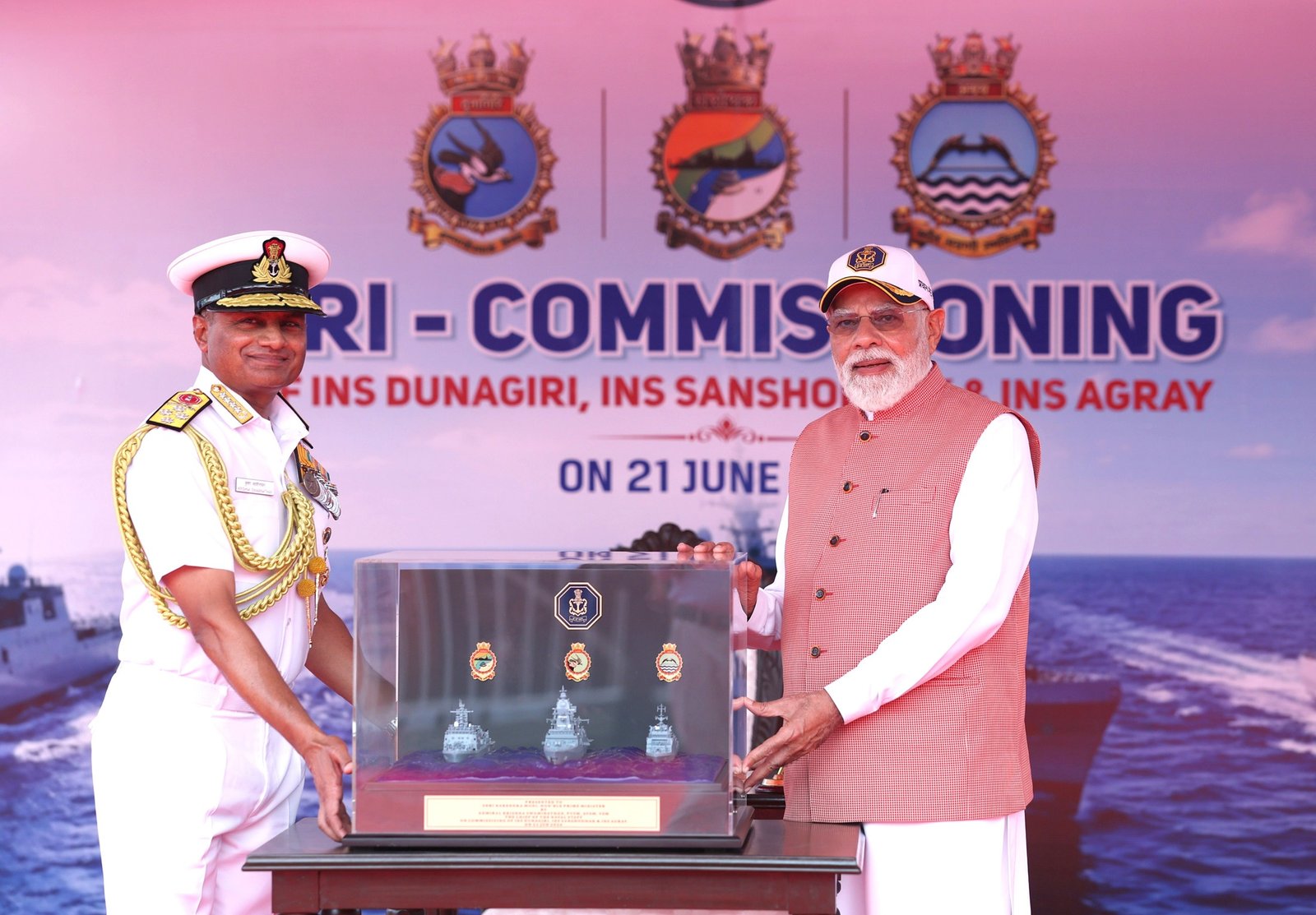
KOLKATA — Marking a historic milestone for India’s defense indigenization, Prime Minister Narendra Modi commissioned three state-of-the-art, indigenously designed and built naval platforms at the Syama Prasad Mookerjee Port in Kolkata.
The simultaneous induction of INS Dunagiri, INS Sanshodhak, and INS Agray into the Indian Navy significantly boosts maritime domain awareness, enhances coastal security architecture, and expands India’s operational reach across critical sea lanes amidst growing geopolitical dynamics in the Indian Ocean Region (IOR).
The New Naval Triumvirate
Designed by the Indian Navy’s premier Warship Design Bureau and constructed by Kolkata-based defense shipyard Garden Reach Shipbuilders & Engineers (GRSE), the three vessels boast an indigenous content of over 75%, powered by an industrial supply chain featuring more than 200 domestic MSMEs.
-
INS Dunagiri (Advanced Stealth Frigate): An advanced guided-missile stealth frigate designed to evade enemy radar while packing formidable anti-surface, anti-air, and anti-submarine offensive weapon suites.
-
INS Sanshodhak (Survey Vessel – Large): A massive, high-tech hydrographic survey vessel tasked with deep-sea exploration, mapping navigation routes, and identifying underwater resources. Coincidentally, its commissioning fell exactly on World Hydrography Day (June 21).
-
INS Agray (Anti-Submarine Warfare Shallow Water Craft): A highly specialized anti-submarine warfare shallow water craft (ASW-SWC) engineered to track, detect, and neutralize stealth underwater threats in coastal littoral waters.
Key Takeaways from the Prime Minister’s Address
On Maritime Power and Global Influence:
“The country whose maritime strength is robust, its economic and strategic influence will be equally robust. Development, security, and prosperity are closely linked to the oceans. Critical minerals, deep-sea resources, and future energy loops will increasingly run through the maritime domain.”
Transitioning from Buyer to Global Producer:
“The strength of a military cannot be measured by its dependence on global markets but by its ability to become self-reliant. India does not wish to remain merely a buyer. India seeks to become a producer and a manufacturer because nations that manufacture become decisive players on the global stage.”
India’s Defense Manufacturing Revolution in Numbers
The Prime Minister highlighted how clear policies and combined stakeholder effort over the last decade have structurally altered the country’s defense ledger from an import-dependent economy into an engineering hub:
-
Skyrocketing Production Value: India’s total domestic defense production skyrocketed from ₹40,000 crore in 2014 to nearly ₹1.8 lakh crore in 2026.
-
Fleet Modernization Rate: Over 40 indigenously built warships and submarines have been seamlessly integrated into the Navy in recent years.
-
Future Pipeline Assets: An additional 45 major naval platforms are currently under various stages of construction across domestic shipyards.
-
Industrial Capital Infusion: The government’s newly rolled-out ₹70,000 crore incentive package for the shipping and shipbuilding sectors is functioning as an industrial multiplier to slash national logistics costs under the wider Sagarmala layout.
Bengal’s Pivot in India’s Blue Economy
The PM explicitly underscored West Bengal’s critical geopolitical location and rich legacy, noting that the waters of the Hooghly River have historically connected India to global maritime trade routes. With these advanced warships taking shape in the state, West Bengal is uniquely positioned to morph into India’s primary eastern gateway for the Blue Economy, maritime supply-chain logistics, and advanced multi-axle coastal industrial manufacturing.
