



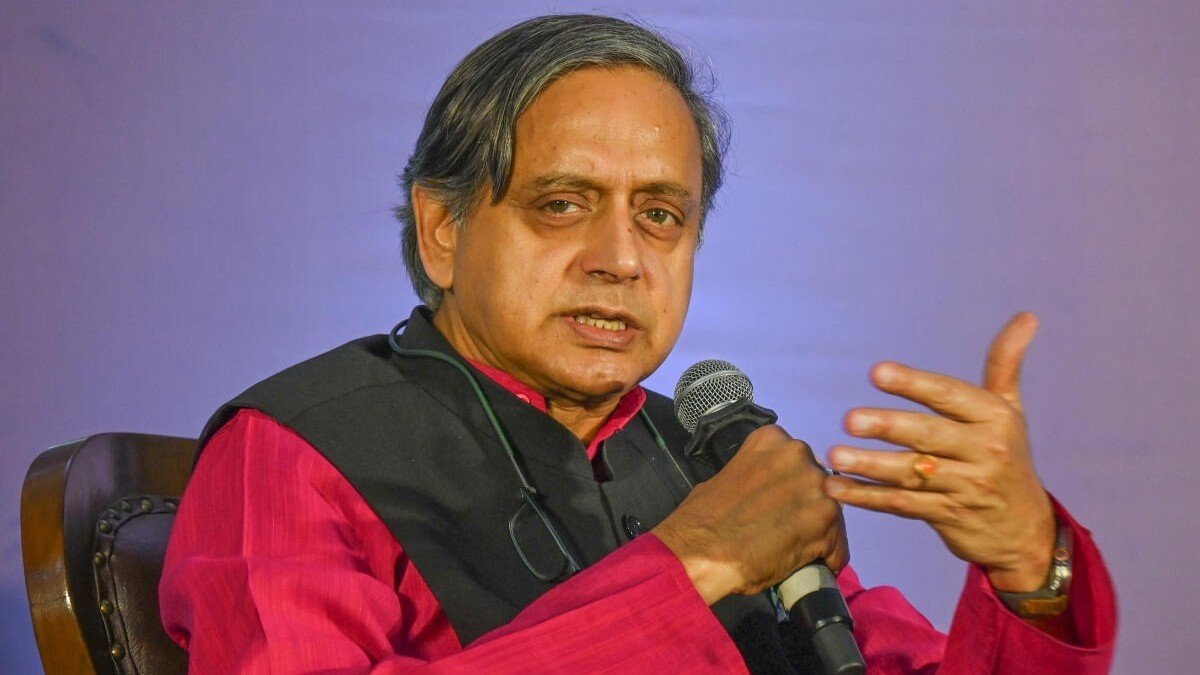
THIRUVANANTHAPURAM: The political row over national protocols has deepened as Congress MP Shashi Tharoor strongly critiqued the mandate requiring all five verses of Vande Mataram to be sung at both the opening and closing of official events. Labeling the practice “unnecessary and burdensome” for the public, Tharoor clarified that while the national song commands universal respect, enforcing its full version twice during short programs is structurally difficult to justify.
The comments have triggered a sharp counter-offensive from the Bharatiya Janata Party (BJP), which maintains that full rendering is a non-negotiable statutory protocol.
The Practical Objections to Double-Recitals
Speaking to reporters regarding the ongoing controversy in Kerala, Tharoor focused his arguments on administrative efficiency and established conventions rather than the content of the song itself:
-
Departure from Custom: Historically, a shorter rendering—consisting of the first verse or two, which most citizens know by heart—was performed once at the start of a function, with the national anthem closing the event.
-
Audience Fatigue: Enforcing all five verses at both the beginning and the end forces attendees to stand through a lengthy, relatively unfamiliar recital twice. Tharoor highlighted a recent book launch in New Delhi attended by Vice President C P Radhakrishnan where this repetition caused noticeable discomfort among the audience.
-
Absence of Parliamentary Law: The MP pointed out that no specific law has been passed by Parliament enforcing this dual, full-length format. He noted that while the Kerala government views the full singing as optional, Governor Rajendra Vishwanath Arlekar holds a conflicting stance, meaning the matter may ultimately require legal adjudication.
“I don’t see the rationale for it, and it is not particularly efficient either,” Tharoor remarked, adding that while the full song is appropriate for major ceremonial occasions involving the President, Vice President, or Prime Minister, it disrupts shorter public programs.
BJP Counter-Attack: Guidelines Are Absolute
The BJP moved swiftly to reject Tharoor’s stance, framing compliance with the song’s full stanzas as a matter of national compliance rather than regional preference.
-
Explicit MHA Directives: BJP leader Amit Malviya stated on X that the Ministry of Home Affairs (MHA) guidelines are explicit. Whenever Vande Mataram is performed at official functions, the full official version must be sung with the audience standing at attention.
-
Political Alignment Allegations: BJP spokesperson Shehzad Poonawala claimed that the Congress party’s pushback against the full rendition is a tactical concession to political pressure from its regional ally, the Muslim League.
Historical Realignment
Originally written by Bankim Chandra Chatterjee in the 1870s, Vande Mataram was formally granted equal status to the national anthem by the Constituent Assembly of India on January 24, 1950.
The current dispute stems from a Union Home Ministry directive implemented earlier this year, which mandated the singing of Vande Mataram before the national anthem (Jana Gana Mana) at all government functions and schools. This directive brought back all six stanzas of the song—including four that were removed by a Congress committee decision in 1937—and formalized the strict requirement for audiences to stand at attention throughout the performance.
