



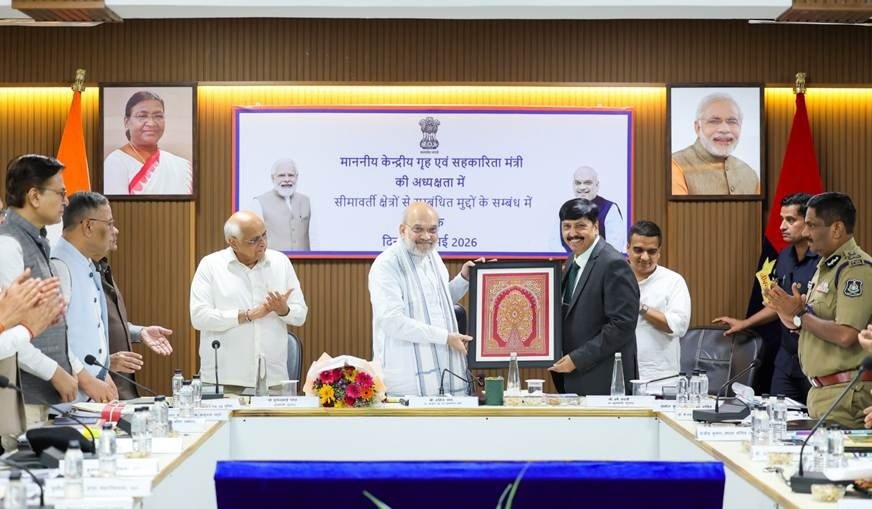
BHUJ: In a major move to fortify national security along the western frontier, Union Home Minister and Minister of Cooperation, Shri Amit Shah, chaired a comprehensive security review meeting in Bhuj, Gujarat. The high-level session focused entirely on addressing emerging threats, operational challenges, and border management strategies across the coastal and border districts of Gujarat situated along the India-Pakistan Border (IPB).
The meeting saw the active participation of Gujarat’s Chief Minister, Deputy Chief Minister, Chief Secretary, and Director General of Police (DGP), alongside senior state officials, District Magistrates (DMs), and Superintendents of Police (SPs) from Kutch, Vav-Tharad, and Patan.
Transformation of Gujarat’s Security Landscape
Shri Amit Shah highlighted that a combination of enhanced infrastructure, maritime vigilance, and decisive governance has fundamentally altered the state’s security matrix:
-
Cessation of Infiltration: Enhanced border fencing, robust maritime security, and the firm political resolve of the state government have resulted in a complete cessation of cross-border infiltration and smuggling.
-
Zero-Tolerance on Encroachments: The Home Minister mandated a strict zero-tolerance approach toward all unauthorized encroachments within a 0 to 15-km radius of the international border, ordering their complete elimination.
-
Vigilance on Radicalization: Local authorities were directed to maintain a sharp, continuous vigil over centers of radicalization within sensitive border zones.
Demographics, Deportation, and Local SOPs
The border management blueprint places heavy accountability on grass-roots administration and intelligence gathering:
-
Demographic Monitoring: District Magistrates must strictly monitor and provide regular analytical reports on demographic changes occurring within border districts.
-
Reversing Migration: The establishment of industrial units in border areas has successfully catalyzed reverse migration, a trend the Home Minister welcomed as a positive development for border stabilization.
-
Deportation Pipeline: To ensure the repatriation and deportation of already settled illegal infiltrators, administrative layers—from local police stations down to the village Patwari—must operate in total unison.
-
District-Specific SOPs: Local administrations are tasked with formulating Standard Operating Procedures (SOPs) tailored to the unique challenges of each border district, focusing heavily on identifying existing infiltrators and countering threats related to drones and narcotics.
Formation of District Security Coordination Groups
To choke off the financial networks fueling cross-border crimes, the Home Minister ordered a highly integrated inter-agency framework:
-
Multi-Agency Task Force: A Security Coordination Group will be established in every border district. This group will comprise representatives from the Border Security Force (BSF), Indian Coast Guard, Income Tax Department, Enforcement Directorate (ED), and the Lead Bank Manager.
-
Financial Oversight: Agencies fighting economic crimes must maintain strict oversight regarding border areas. The Income Tax Department, in collaboration with the Reserve Bank of India (RBI), will launch comprehensive survey drives targeting hawala transactions, suspicious financial dealings, mule accounts, shell companies, questionable vehicles, and abnormal GST collections.
-
Shared Accountability: The direct legal responsibility for the effective enforcement of Income Tax, Anti-Money Laundering (PMLA), and Customs laws will now explicitly rest with the respective DM, SP, and Inspector General (IG) of the Border Range.
Priority on Coastal Security and Village Saturation
Given the strategic proximity to the International Maritime Boundary Line (IMBL), the Home Minister ordered the state machinery to prioritize coastal security through seamless operational coordination with the Indian Coast Guard.
Furthermore, to ensure the holistic development and resilience of frontline populations, Shri Amit Shah directed that alongside the ongoing ‘Vibrant Villages’ initiative, the administration must achieve 100% saturation of all Central and State government welfare schemes within border villages.
