



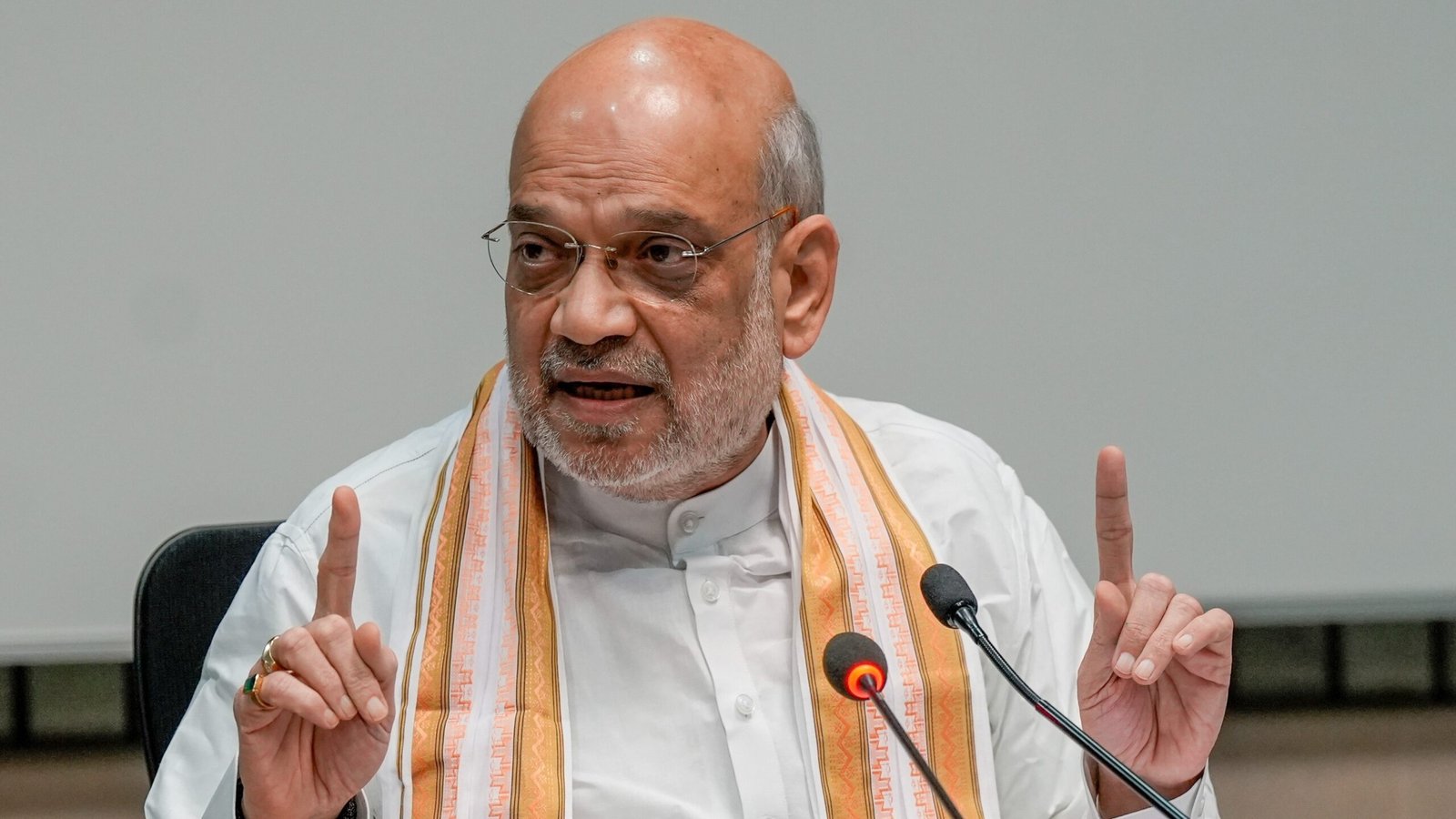
BIKANER: To significantly upgrade national security along the Indo-Pakistan Border (IPB), Union Home Minister and Minister of Cooperation Amit Shah chaired a high-level security review meeting in Bikaner, Rajasthan. The executive session established a comprehensive, inter-agency framework to tackle cross-border crimes, economic offenses, and infrastructural gaps in the region.
The high-profile meeting was attended by Rajasthan Chief Minister Bhajan Lal Sharma, senior state bureaucrats, and the District Magistrates (DMs) and Superintendents of Police (SPs) of five critical border districts: Bikaner, Jaisalmer, Barmer, Sri Ganganagar, and Phalodi.
Strategic Directive: The 360-Degree Security Framework
The Ministry of Home Affairs (MHA) has ordered the immediate deployment of a multi-tiered security architecture designed to integrate local communities with state and central enforcement mechanisms:
-
Zero-Tolerance Zone: The Home Minister issued strict instructions to enforce a zero-tolerance policy against unauthorized infrastructure. All illegal constructions located within 0 to 15 kilometers of the international border are slated for immediate demolition.
-
Unified Enforcement Command: To eliminate institutional silos, the central government is integrating the operational capabilities of the Border Security Force (BSF), Central Board of Direct Taxes (CBDT), Narcotics Control Bureau (NCB), and Rajasthan State Police. This unified grid will target human infiltration, narcotics trafficking, encroachment, and terror financing.
-
Last-Mile Governance Transformation: The meeting prioritized the execution of the Vibrant Village Programme-II (VVP-II). The initiative mandates 100% saturation of central welfare schemes in border villages to improve the quality of life for the local population, effectively checking outward migration and reinforcing national security.
Enhanced Financial & Digital Vigilance Mandated for DMs
A major highlight of the security review was the expanded role assigned to District Magistrates, shifting border management from purely physical surveillance to rigorous economic and digital auditing:
-
Financial Scrutiny: DMs must now oversee complete legal and financial compliance across local banking institutions. This includes the proactive tracking of mule accounts, shell companies, and anomalous funding streams tied to major local business establishments.
-
Identity Verification: Special emphasis was placed on launching coordinated drives to detect and eliminate forged identity documents and counterfeit credentials used to facilitate illicit cross-border movements or financial frauds.
-
Cyber Defense & Judicial Reforms: The Home Minister directed administrative heads to maximize the utilization of the ‘1930’ cybercrime helpline for rapid fraud redressal. Simultaneously, districts were instructed to ensure the flawless, ground-level implementation of India’s three new criminal laws to modernize criminal prosecutions and law enforcement procedures.
The MHA concluded that the federal government remains firmly committed to maintaining the highest security benchmarks on India’s international borders, leveraging deep institutional synergy between central forces and state administrative machinery.
