



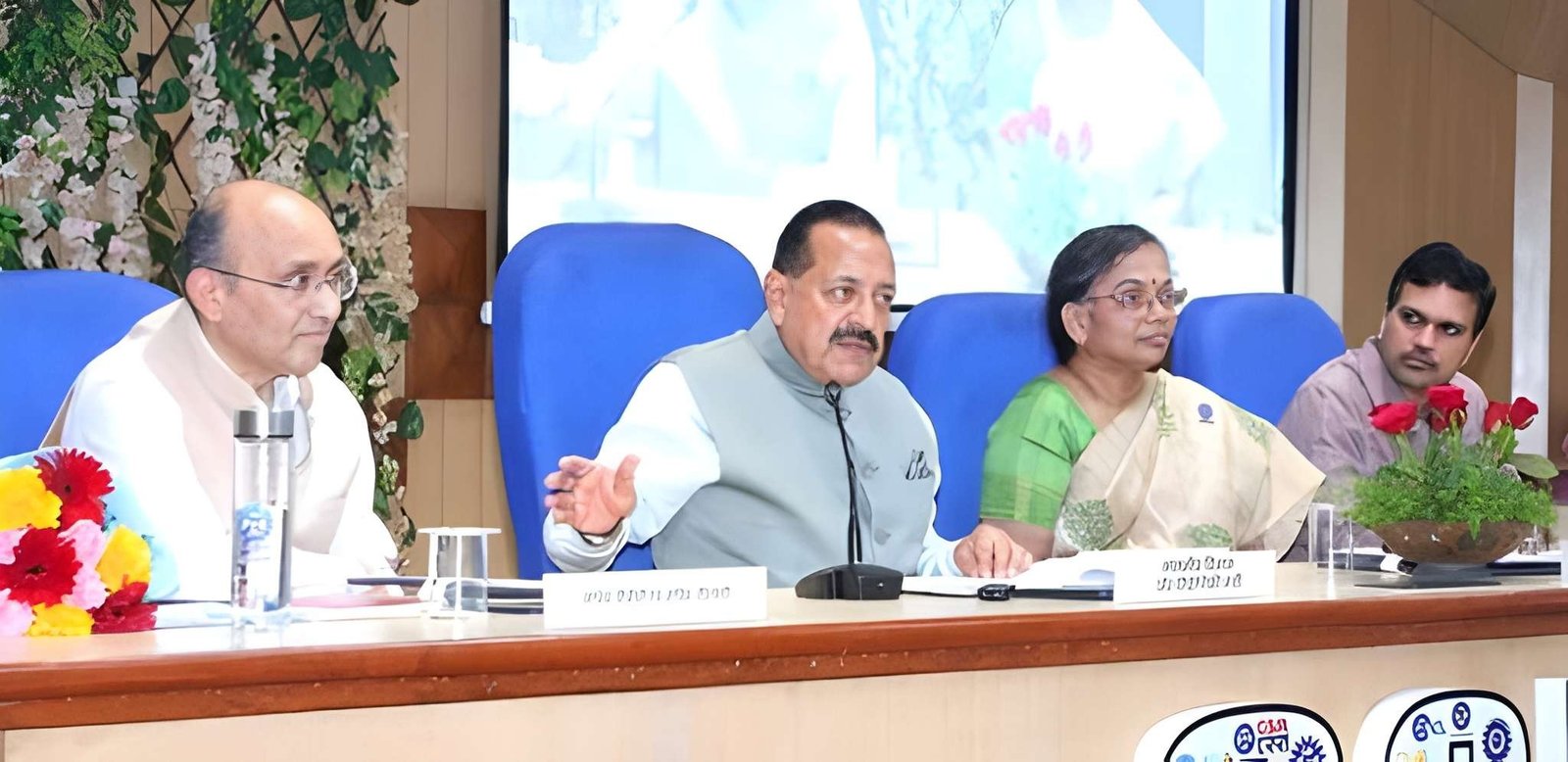
NEW DELHI — Addressing a high-level press conference at the CSIR Headquarters, Union Minister of State for Science & Technology Dr. Jitendra Singh unveiled a comprehensive review titled “12 Years of Transformative Growth in Science, Technology and Innovation.”
The Minister detailed how India’s scientific ecosystem has successfully transitioned from isolated laboratory research to a core driver of public welfare and macroeconomic growth, moving the nation closer to its Viksit Bharat 2047 vision.
Key Pillars of the 12-Year Transformation
I. The Biotechnology Explosion
India’s bioeconomy has experienced an aggressive, nearly twenty-fold expansion over the last twelve years, shifting from a niche sector to a primary economic pillar.
-
Exponential Scale: The national bioeconomy has surged from $10 billion in 2014 to over $190 billion today, with policy frameworks like the BioE3 initiative steering the sector toward a target of $300 billion by 2030.
-
Clinical Breakthroughs: Breakthroughs in healthcare infrastructure include indigenous genomics modeling, affordable CAR-T cell therapies, and next-generation antibiotics designed to tackle both domestic and global health challenges.
II. The Privatization & Expansion of the Space Frontier
Following historic structural reforms, India’s space ecosystem has pivoted from an exclusively state-run domain to a thriving commercial market.
-
Startup Multiplier: The number of active private space tech startups has ballooned from single digits to over 400 firms.
-
Market Capitalization: Driven by private-sector integration and the global prestige of the Chandrayaan-3 lunar south pole landing, India’s space economy is projected to jump from $8 billion to $45 billion in the coming years.
-
The Horizon Plan: The Ministry confirmed formalized timelines for the establishment of the Bharatiya Antariksh Station by 2035 and an independent Indian manned landing on the Moon by 2040.
III. Radical Overhaul of Climate and Weather Infrastructure
Under Mission Mausam, the India Meteorological Department (IMD) has rapidly scaled its predictive capabilities to safeguard agriculture and strengthen disaster response management.
-
Radar Density: The operational Doppler weather radar network has expanded from 17 radars in 2014 to nearly 50 radars today, with an additional 50 systems currently in the pipeline.
-
Granular Forecasts: Hyper-localized forecasting coverage has expanded from 300 cities to nearly 1,700 locations, allowing real-time Nowcast networks to provide immediate, short-term alerts to farmers and disaster management teams.
Strategic Materials and Sovereign Innovations
The review highlighted several indigenous technologies developed under the Council of Scientific and Industrial Research (CSIR) and partner ministries that are currently being deployed at commercial scale:
-
Steel Slag Road Technology: An eco-friendly infrastructure framework that processes toxic industrial waste into ultra-durable, low-maintenance national highway surfaces.
-
Deep Ocean Engineering: Under the Deep Ocean Mission, India is actively testing deep-sea exploration technologies, notably the Matsya 6000 manned submersible and the Varaha deep-sea mining system.
-
Strategic Energy Deregulation: Acknowledged as a major policy shift, the nuclear energy sector has officially been opened to private-sector participation to accelerate domestic capacity creation and attract international technology investments.
-
Institutional Funding Vehicles: Scientific R&D will be systematically accelerated through newly established national frameworks, including the Anusandhan National Research Foundation (ANRF) and the National Quantum Mission.
