



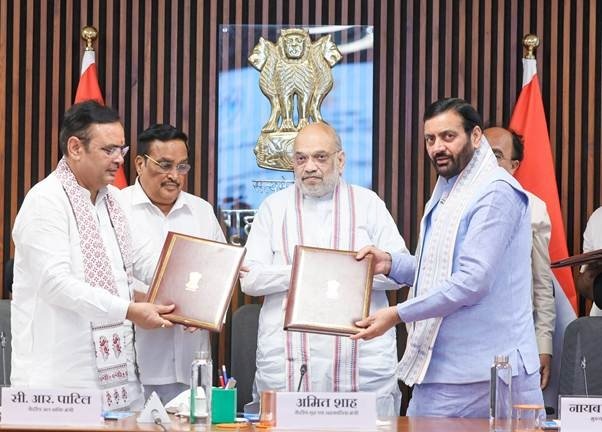
NEW DELHI — In a major breakthrough for inter-state water management, the governments of Rajasthan and Haryana have officially signed a historic agreement to construct and implement the Yamuna Water Project.
The pact was signed in New Delhi in the presence of Union Home Minister Shri Amit Shah, Rajasthan Chief Minister Shri Bhajan Lal Sharma, Haryana Chief Minister Shri Nayab Singh Saini, and Union Jal Shakti Minister Shri C. R. Patil. The agreement successfully resolves a complex, three-decade-old water sharing dispute between the two neighboring states.
Technical Framework: Conveyance via Underground Pipelines
The core of the agreement revolves around the scientific optimization of surplus monsoon rainwater from the Yamuna River, which previously went unutilized. The project builds directly upon the foundational allocation metrics established in the 1994 Memorandum of Understanding (MoU) for the Upper Yamuna Basin.
Engineering & Supply Metrics:
-
Volumetric Allocation: Approximately 580 Million Cubic Meters (MCM) of water will be diverted from the Western Yamuna Canal to Rajasthan annually during the monsoon block from July to October.
-
Pipeline Architecture: The water will be transported via three massive underground pipelines, each boasting a diameter exceeding 3.6 meters.
-
Groundwater Recharge: Beyond immediate drinking water consumption, the diverted pipeline water will be channeled into a network of large local ponds to systematically recharge depleting water tables.
Regional Impact and Beneficiary Districts
The underground pipeline system will run through critical, water-stressed regions of both states, providing a reliable source of clean drinking water to millions of citizens in arid and semi-arid zones.
-
Rajasthan Impact Zones: Sikar, Churu, and Jhunjhunu districts.
-
Haryana Impact Zones: Bhiwani and Fatehabad areas.
Operational Governance and Dispute Resolution
The newly inked framework has been drafted in close coordination with the Central Water Commission (CWC) to function as a long-term, dispute-free model. To avoid future friction, the legally binding text clearly outlines specific operational parameters:
“This agreement is an excellent example of a Win-Win Situation for both states. It has carefully addressed financial responsibilities, cost-sharing, water allocation, water release protocols, and maintenance arrangements.” — Shri Amit Shah, Union Home Minister
By integrating rigorous monitoring systems, real-time data transparency measures, and a structured legal dispute resolution mechanism, the Ministry of Jal Shakti aims to set a new benchmark for “Solution through Dialogue” and cooperative federalism in national river-linking and water-diversion initiatives.
