



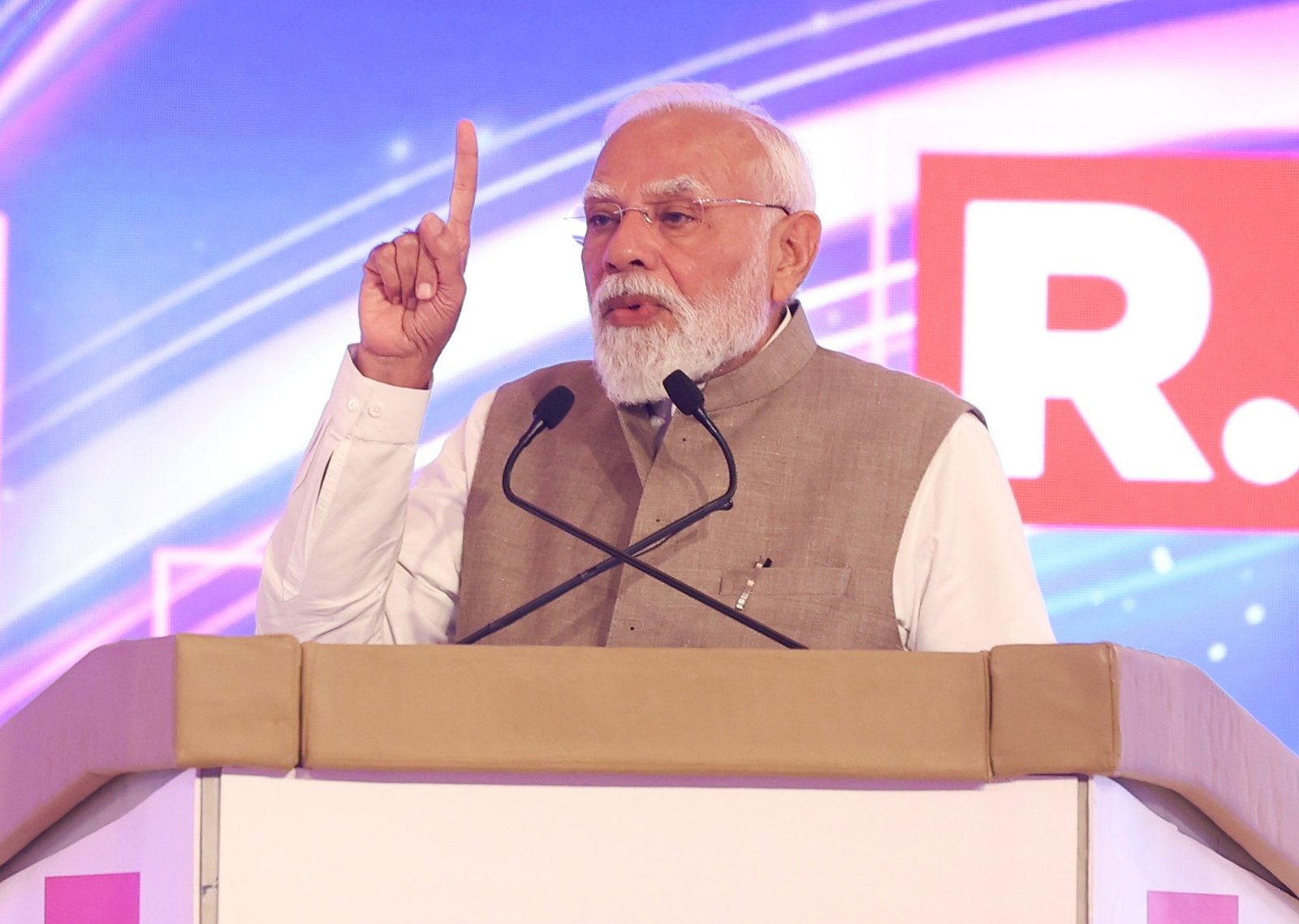
NEW DELHI — Prime Minister Shri Narendra Modi delivered a keynote address at the Republic Summit 2026, framing India’s rapid economic ascent and internal stability as the foundation for writing the global history of the next millennium. Speaking on the theme “Great Power India: Nation First,” the Prime Minister synthesized the milestone achievements of his administration’s 12-year tenure, drawing a direct line between aggressive grassroots development and macroscopic national power.
Redefining Global Power: Reliable, Credible, and Non-Reactive
The Prime Minister asserted that India’s global standing has evolved beyond that of a mere fast-growing market, emerging instead as a pillar of geopolitical certainty.
-
A Thousand-Year Horizon: Drawing on civilizational memory, PM Modi stated that India’s contemporary policy decisions are designed with long-term, inter-generational foresight. “What India is doing today will write the future of the next thousand years,” he noted.
-
The Credibility Factor: Fresh off his attendance at the G7 Summit, the Prime Minister shared that international heads of state explicitly recognize India as a “reliable power” anchored tightly by the principle of “Nation First.”
-
National Spirit as an Economic Driver: Key domestic programs like Make in India, Swachh Bharat, and the revival of indigenous industries succeeded fundamentally because citizens placed national advancement over personal ease. He specifically lauded home-grown tech entrepreneurs, pointing to the global footprint of Zoho and its founder Sridhar Vembu at VivaTech in France as prime examples of Indian innovation driving international interest.
Dismantling Left-Wing Extremism Through Grassroots Infrastructure
In a detailed overview of internal security, the Prime Minister highlighted the near-total containment of Maoist and Naxalite insurgencies across India’s tribal regions, contrasting current stability with the violence of the preceding decade.
-
The Scale of Past Violence: PM Modi cited data from 2004 to 2014, noting that Naxalite terror accounted for over 17,000 violent incidents and nearly 7,000 deaths during that period, completely blocking development in tribal belts.
-
The Strategic Blueprint for Peace: Rather than relying solely on tactical force, the administration deployed a multi-pronged infrastructure push over the past 12 years to win back the trust of isolated populations:
| Infrastructure Metric | Total Deployment in Naxal-Affected Zones |
| Road Construction | 12,000+ Kilometers |
| Mobile Connectivity | 9,500+ Towers across 45,000 Villages |
| Financial Inclusion | 1,800+ Bank Branches & 75,000 Banking Correspondents |
| Postal Services | 6,000+ New Post Offices |
-
The Bastar Olympic Shift: The security overhauls have yielded a massive cultural transition. In Bastar, previously an epicenter of conflict, the government now hosts the Bastar Olympics, which saw participation swell from 1.5 lakh youth in its first edition to nearly 4 lakh youth in its second iteration.
From Despair to Aspiration: Navigating a New Middle-Class Reality
The Prime Minister labeled the psychological shift from systemic defeatism to upward aspiration as the greatest triumph of his 12 years in office. He highlighted the “Aspirational Districts and Blocks” program, which systematically targeted development parameters in lagging areas, helping lift 250 million people out of poverty and transitioning them into a consumption-driven neo-middle class.
To insulate this vast demographic, the government executed comprehensive structural overhauls aimed at lowering living expenses and easing administrative friction:
-
Real Estate Security: Implemented a targeted ₹25,000 crore special fund to salvage stalled housing projects, successfully delivering nearly 60,000 long-delayed urban apartments to families previously stuck paying both rent and home loans.
-
Mass Transit Boom: Highlighted the exponential growth of urban rail, with daily metro commuters surging from 2.8 million in 2014 to 12.8 million in 2026, complemented by the network expansion of high-speed Vande Bharat, Namo Bharat, and Amrit Bharat trains.
-
Tax Rationalization: Noted that while income up to ₹2 lakh was taxable in 2013-14, policy structural shifts have now made income up to ₹12 lakh completely tax-free, significantly increasing disposable household savings.
-
Healthcare Subsidies: Saved middle-class families approximately ₹40,000 crore through the Jan Aushadhi network by providing chronic lifestyle medicines at an 80% discount, coupled with introducing free healthcare up to ₹5 lakh for all senior citizens over the age of 70.
Confronting “Chronic Dissatisfaction” and Moving Forward
The Prime Minister concluded his address with a sharp critique of the contemporary opposition, particularly the Congress party. He cautioned the public—especially Gen Z—to remain vigilant against political factions that engage in automated, contradictory criticism.
PM Modi pointed out the policy contradictions of his critics: demanding uninterrupted power while protesting green energy plants, criticizing India’s position in global AI while opposing domestic semiconductor foundries, and questioning defense readiness while actively trying to derail modern military procurement deals.
Reiterating that India is securely aboard the “Reform Express,” the Prime Minister promised that the collective ambition of 1.4 billion citizens would see the realization of a fully developed nation within the lifetime of the current generation.
